

Policymakers lack a clear overview of the AI supply chain. Without it, they face constrained policy space and limited scope to build geo-economic leverage.

Read on as Kitrhona Cerri, Executive Director of the TASC Platform, examines what current AI governance debates may be overlooking, and why understanding where power, leverage and opportunity sit across the AI supply chain could open new possibilities for policy action and international cooperation.
Are AI Governance discussions too forward-looking? At TASC we are more accustomed to highlighting the opposite challenge – ‘Thinking Ahead’ is in our name. But, as leading minds, media space and multilateral dialogues are caught up in lofty questions of machine consciousness, alignment and existential risk, substantive policy action and cooperation remain elusive.
We cannot help but ask: are our policymakers being distracted?
Current AI Governance debates are focused on regulating and scaling the use of frontier AI models. That is, on managing potential risks, avoiding hypothetical negative use-cases and investing in speculative opportunities. Whether any of these scenarios materialise depends on the capacity and dynamics of the AI supply chain - where significant social, economic and geopolitical impacts are playing out now.
This is where power and leverage are being consolidated, and where actors seeking influence in the future of AI need to engage – however the perspective is largely absent in leading policy discourse. There is a passing mention in the Preliminary Report of the UN Independent International Scientific Panel on AI (IISP-AI) saying “further investigation is needed to understand it’s full impacts”. Pope Leo XIV’s first encyclical urges careful examination, while the World Bank counsels realism and the local application of existing AI products.
“I would encourage a careful examination of the supply chains of digital production, the working conditions hidden behind our devices and the mechanisms that profit from manipulation and war. At the same time, practical ways of fostering fairness, participation and care for creation must be found.”
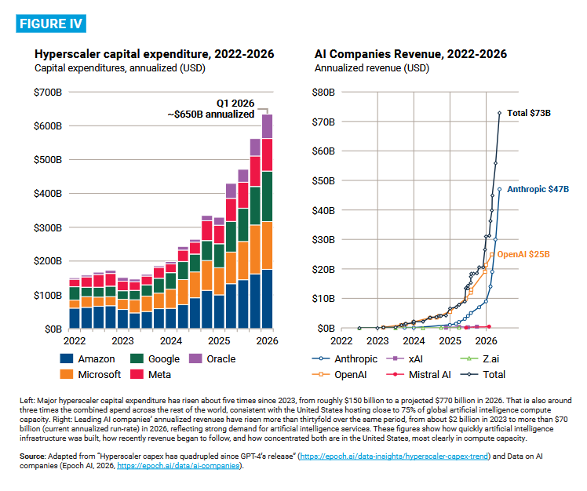
From the Preliminary Report of the IISP-AI, p.28
The majority of AI policy advice recommends regulatory attention to AI use alongside more investment in AI adoption, while skimming over the full scope of AI supply.
The overwhelming motivator is the risk of ‘being left behind’ in an AI-driven future. The argument goes: the speed and scale of investment needed to influence AI development is far out of reach for most actors and nations. The only remaining option is to drive local applications and uptake as fast as possible.
But policymakers receiving this advice could raise a different question:
Is the power to determine the future a race to be won, or a freedom to be protected?
From a governance perspective, the answer matters. It influences whether regulation and policy intervention are seen as stiflers of innovation or guardians of human safety, rights and freedoms, and stimulators of opportunity for a broader share of global citizens.
This question sits at the heart of the TASC Platform’s AI Governance Programme, which explores governance across the entire AI supply chain, asking where debates and action are currently focused, and what is being overlooked.
Policymakers need a clear view of the AI supply chain to act upon the broad range of risks and opportunities along it. Could a better understanding of these dynamics open up policy space, inform points of geo-economic leverage, and enable a broader range of actors to influence AI transformation?
To find out, we have laid out the simplified chain below as a foundation for more grounded discussion.
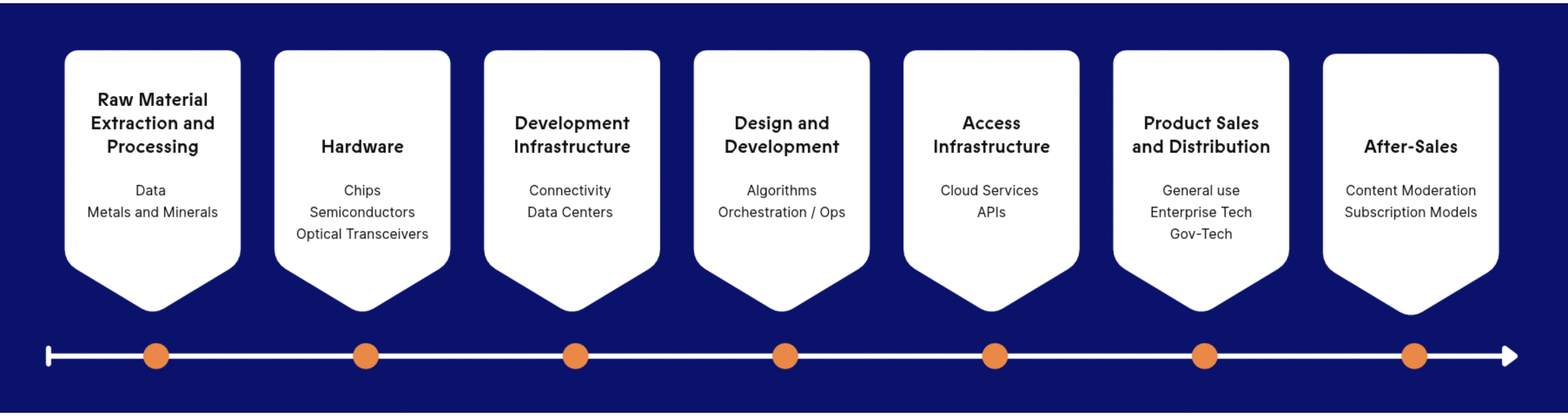
We are keen to improve and build on this overview as an entry point for policymakers, and to collectively examine each level through four interconnected lenses: power, people, prospects and policy:
Power: Points of concentration and friction in AI supply are increasingly documented. The IISP-AI lays out concentration at market (multiple steps where a single provider has over 80% of the global market), geographic (the US hosts ~75% of AI computing power) and sector levels (91% of models originate in the private sector). Meanwhile resource bottlenecks are posing barriers to scale (e.g. copper, compute, energy, land, water). Are there opportunities for participation or leverage from other actors?
People: Despite rising concerns of rogue agents, AI product development and application depends on people. But who and where are they? Building on research and discussions on agentic AI, AI developers, data workers, we aim to map humans in the AI supply chain. What are their roles, circumstances, and levels of control and accountability?
Prospects: While there is no shortage of visions of AI-driven futures, a supply chain perspective offers a closer look at prospects for governments seeking to strengthen their geo-economic position. What are future implications for workforces and communities? Can countries drive digital dividends without entrenching new dependencies? What alternatives could be imagined and influenced?
Policy: AI does not exist in a policy vacuum. Experts and advocates are putting forward existing laws, governance models and principles that could be adapted and applied to better manage AI growth and transformation. The supply chain offers a structure to map this broad range of current and potential policy space, alliances and tools. Can we accelerate policy efforts by learning from and transferring approaches across fields, industries and geographies?
We are not the only people thinking about this. A wealth of insight and expertise exists across this spectrum. A key challenge is to make it accessible, digestible and applicable for the broad range of policymakers that need to act – independently and in cooperation - on AI governance and implementation.
Using the AI supply chain as an entry point to credible, cross-silo expertise, opportunities for exchange, and a menu of realistic policy and governance opportunities could fuel more informed, targeted action to influence AI transformation.
This article forms part of the TASC Platform’s AI Governance Programme.
The programme builds on TASC’s work since 2023 at the intersection of AI, foresight and creativity and its engagement with the AI for Good Global Summit. It connects research, policy and practice across the AI supply chain to deepen understanding of emerging governance challenges, strengthen exchange and develop practical pathways for action. This work also feeds into the wider conversations and preparations leading towards the Geneva AI Summit 2027.