

Who Shapes AI Governance?
allocating Accountability Across the AI Value Chain
These event highlights capture key governance insights from the Use at Your Own Risk? Integrating Developers into AI Governance, convened alongside the first UN Global Dialogue on AI Governance.
Co-hosted by the TASC Platform, Cognizant, The Adecco Group and the Geneva Policy Outlook, the event explored who is developing AI today, how responsibility is distributed across the AI value chain, and what it takes to turn accountability into governance in practice.
When multi-agent systems increasingly act, negotiate, and make decisions on our behalf, their actions move further from meaningful user control. Those who are responsible for developing these ever more capable and autonomous systems make foundational choices that influence downstream risk, often without taking adequate measures for risk mitigation.
It is against this backdrop that the TASC Platform brought together corporate leaders, researchers, policymakers, and international organisations to examine the central governance question posed by moderator Professor Gudela Grote, Co-Chair of the TASC Platform, Professor Emeritus of Work and Organizational Psychology at ETH Zürich, and Senior Fellow at the Geneva Graduate Institute:
“What does it take, from a governance perspective, to support developers in carrying that accountability?”

Professor Gudela Grote, Co-Chair of the TASC Platform, Professor Emeritus of Work and Organizational Psychology at ETH Zürich, and Senior Fellow at the Geneva Graduate Institute

The discussion explored AI governance through four connected lenses. Guided by this central question, Sarah Mathews, Group Head Responsible AI at The Adecco Group, examined who is developing AI today. Hector de Rivoire, Director, Responsible AI Public Policy at Microsoft explored how responsibility is distributed across AI systems and how governance frameworks are evolving in response, before Brigitte Roy, Head of Partner Sales – DACH & France at Cognizant, reflected on how organisations are operationalising AI governance in practice.
“If AI governance is to be meaningful, it can no longer stop at regulating the use of AI systems. As AI development becomes increasingly distributed, governance must reach design choices. That means understanding who is shaping AI systems today, how responsibility is shared across the AI value chain, and how organisations can build accountability, transparency and trust while managing risk from the outset.”

Kitrhona Cerri, Executive Director, TASC Platform
Who is an ai developer today?
AI governance has traditionally distinguished between developers, deployers and users. Today's rapid adoption of generative AI is increasingly blurring those boundaries.
Drawing on the Adecco Group's experience providing AI talent, developing AI solutions, and advising clients through technology consulting, Sarah Mathews reflected on how AI development is extending beyond traditional engineering teams. Professionals across business functions are now configuring, adapting and integrating AI systems.
ai literacy as a governance capability
This raises a practical governance challenge:
“How can we actually make sure that people have the qualifications they need to work with these systems, to deploy these systems, especially also from a risk angle?”
This question is increasingly reflected in emerging governance expectations, including the EU Artificial Intelligence Act, which introduces AI literacy obligations for providers and deployers of AI systems.
AI literacy therefore becomes more than a compliance requirement. It becomes a governance capability, equipping those designing, adapting and deploying AI systems to recognise, assess and manage risk.
Placing Developers in the AI Value Chain
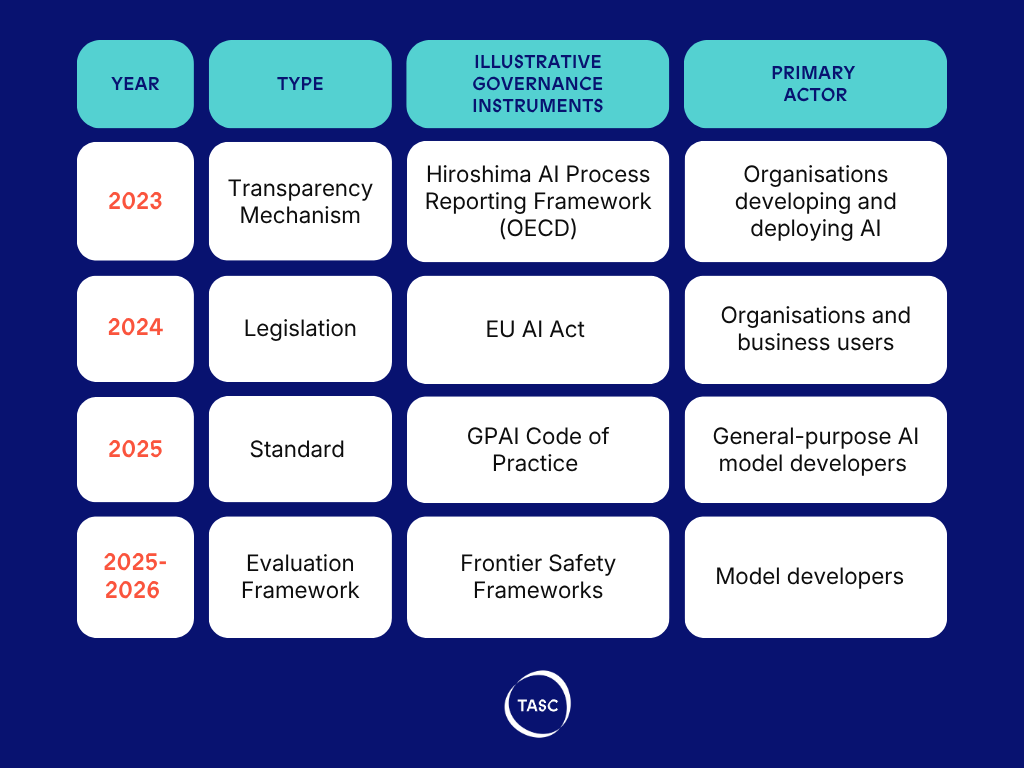
Reflecting on Microsoft's responsible AI journey, Hector de Rivoire broadened the discussion to the AI value chain where foundation model developers, system developers, deployers and users each bring different levels of visibility and risk into AI systems.
In this context, organisations increasingly operate within a growing ecosystem of legislation, international standards, transparency mechanisms and evaluation frameworks. Taken together, these complementary approaches help map governance expectations across the AI value chain, and how responsibility is being distributed in practice.
“The obligations deployed across the value chain also need to match the level of visibility and risk that different entities across the value chain can see.”
Governance in Practice
As governance responsibilities expand across the AI value chain, organisations face a different challenge: how does governance become part of everyday operations?
Last year, on the eve of the AI for Good Global Summit 2025, the TASC Platform convened leaders from industry, research, and international organisations to examine how accountability and control were becoming increasingly fragmented across emerging AI supply chains through agentic AI. Returning one year later, Cognizant offered an organisational perspective on how that challenge is beginning to be addressed in practice.
“We have distributed the accountability. No one is a single point of failure.”
Drawing on its experience deploying AI across clients, products, and internal operations, Brigitte Roy, described an organisational approach that moves accountability beyond individual developers and into operations through structured governance, lifecycle oversight, continuous monitoring, and organisation-wide capability building, complemented by its recent commitment to train5,000 Frontier Certified Engineers and 10,000 Frontier Business Operators by the end of 2026.
Preparing Governance for the Next Generation of AI
Drawing on the field of Organizational Psychology, Professor Gudela Grote closed the conversation with a challenge to organizations: how to share accountability rather than diffuse responsibility. Effective AI governance will depend on ensuring that responsibilities remain visible, clearly assigned, and supported by meaningful human oversight. across the AI supply chain.
As the international conversation continues towards the Geneva AI Summit 2027, the TASC Platform will continue building exchange across disciplines, sectors and institutions. By creating trusted spaces where policymakers, researchers, industry, international organisations and practitioners can challenge assumptions, connect perspectives and develop practical responses together, the Platform helps strengthen the governance ecosystem needed to prepare for the next generation of AI.