

Ahead of the 2026 Annual Forum of the ILO’s Global Coalition for Social Justice, academic partners gathered on 03 September for their second Academic Meeting, to shape the academic engagement and contribution to the Global Coalition.
Co-hosted by the Geneva Graduate Institute, University of Panama, and Stellenbosch University, this exchange explored how research, regional engagement and academic collaboration can translate knowledge into action for social justice. The meeting brought together a community that now counts 46 academic partners, reflecting its growing regional reach and shared commitment to move knowledge into action.
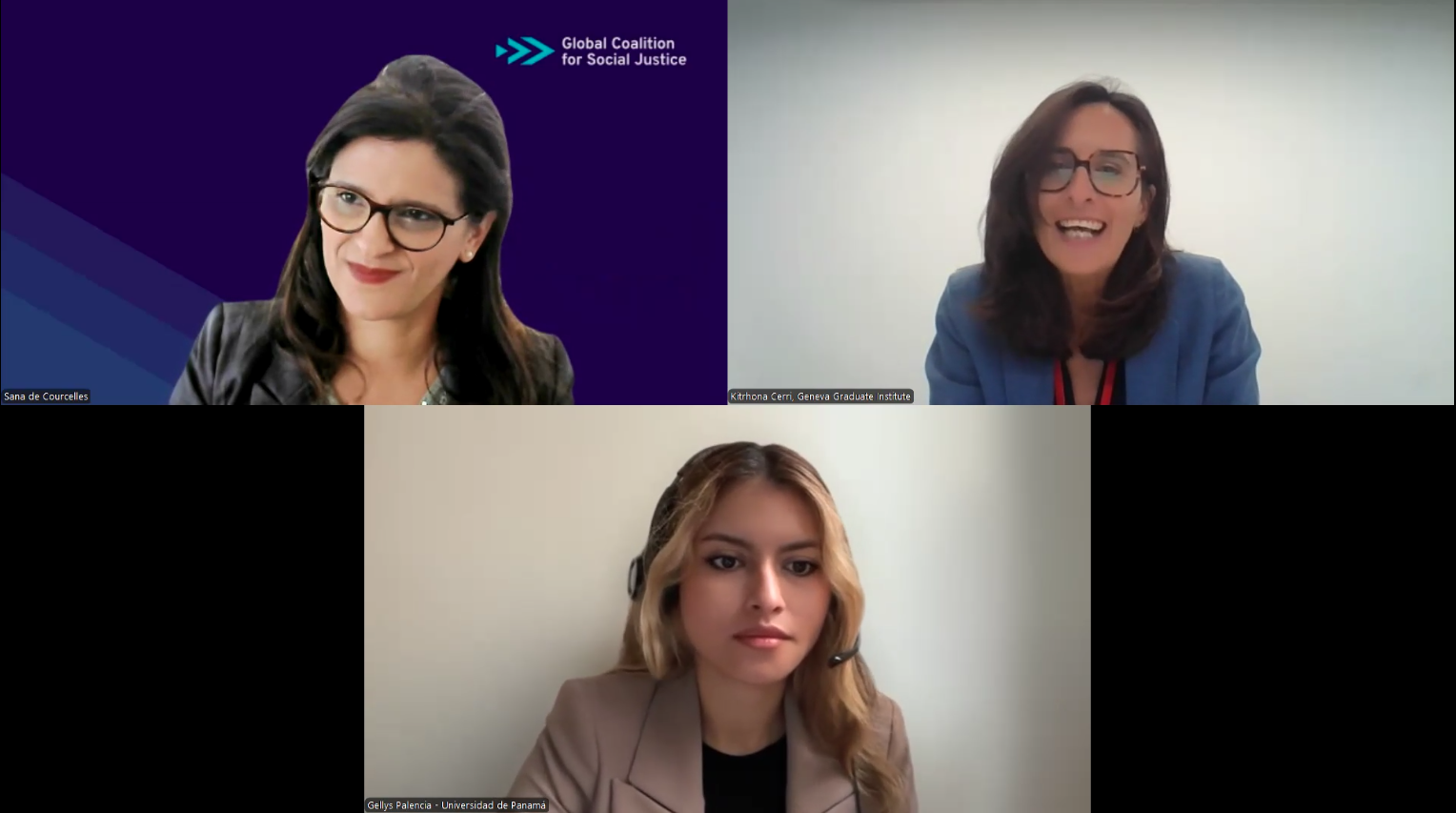
Sana de Courcelles, Director of the Global Coalition for Social Justice Secretariat at the ILO, Kitrhona Cerri, Executive Director of the TASC Platform at the Geneva Graduate Institute, and Gellys Palencia Oyola, legal researcher and Specialist in Social Dialogue and Tripartism at the University of Panama.from knowledge into action
This engagement has gathered momentum through a series of academic partner exchanges. Through its TASC Platform, the Geneva Graduate Institute convened the inaugural Academic Partners Meeting in June 2025, followed by a virtual exchange in December 2025.
Building on this progression, Sana de Courcelles, Director of the Global Coalition for Social Justice Secretariat, presented a framework outlining how academia drives the Coalition forward through 1. knowledge generation, 2. advocacy and engagement, and 3. contributions to the delivery of the 14 key interventions at the heart of the Coalition. These interventions are being deployed to accelerate progress toward the Sustainable Development Goals (SDGs), advance social justice and provide a shared focus for its partners.
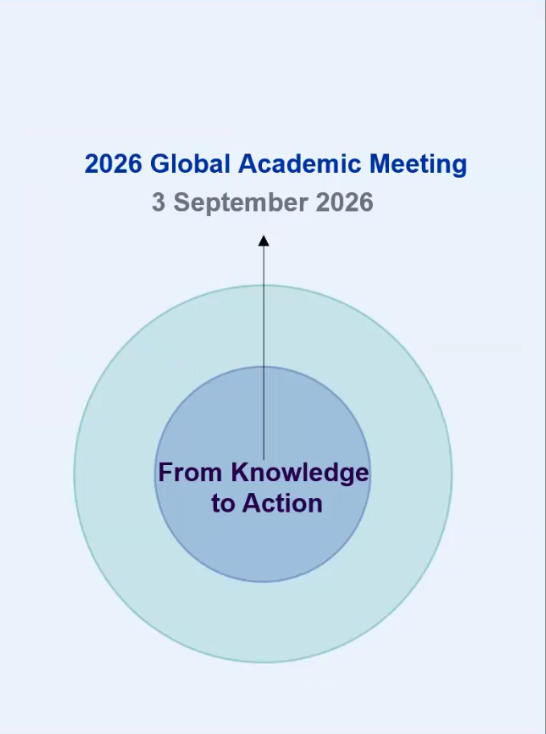
“We invite academic partners to translate your affiliation into concrete commitments for 2026-2027 in order to move from knowledge to exchange, and ultimately to action.”
Putting commitment into practice: Examples from Hosting Institutions
For the past two years, the Geneva Graduate Institute has served as the Academic Representative on the Coalition’s Coordinating Group. The Institute is now delighted to pass the baton to the University of Panama, whose deep commitment to advancing social justice is matched by extensive mobilisation across Latin American and the Caribbean.
Speaking on behalf of Vasco Torres de León, Director of the Inter-American School for Social Dialogue, Tripartism and Conflict Resolution, Gellys Palencia Oyola, legal researcher and Specialist in Social Dialogue and Tripartism, described assuming this responsibility as “an honour and an opportunity to strengthen inclusive mechanisms for academic and regional cooperation”.
Through the School, the University is developing a report on social dialogue across ten Latin American countries, bringing together academics from ten Latin American and four European countries through the Panama Group, and coordinating the Latin American Network of Schools of Social Dialogue, with technical support from the ILO.
Together, these initiatives give practical form to the University’s regional leadership, and place a wider question before the academic community:
“As promoters of scientific knowledge, what are the actions that can create impact and transformation?”
Interdependence and the equal value of different knowledge systems sit at the heart of Stellenbosch University’s contribution to the Coalition.
Its focus on decoloniality, constitutional transformation, and social justice gives practical expression to this principle. Professor Thulisile “Thuli” Madonsela, Director of the Centre for Social Justice and Law Faculty Trust Research Chair on Social Justice, drew upon Ubuntu wisdom, challenging reliance on a single part of the world for answers. She turned to the words of Kenyan environmentalist and Nobel Peace Prize (2004) laureate Wangari Maahtai:
“There comes a time when humanity is called to shift to a new level of consciousness, to reach a higher moral ground, a time when we have to shed our fear and give hope to each other.”
“Our research, teaching and policy tools seek to close the distance between constitutional social justice promises and people’s lived realities.
This reflects Stellenbosch University’s vision of advancing knowledge in service of society, as a university rooted in Africa and connected to the world.”
Stellenbosh University sees three ways to put the academic community’s shared priorities into practice. First, a gender-responsive food-security linking access to food with fair pay, social protection, institutional accountability and women’s unequal care burden when the systems fail. Second, a transformative pedagogy, using participatory approaches to social justice teaching, research and curriculum. Finally, the Social Justice Impact Assessment Matrix (SIAM), a tool for examining, before implementation, how proposed laws and policies may distribute benefits and burdens across differently situated people, and whether the evidence, assumptions and community participation informing those choices are adequate.
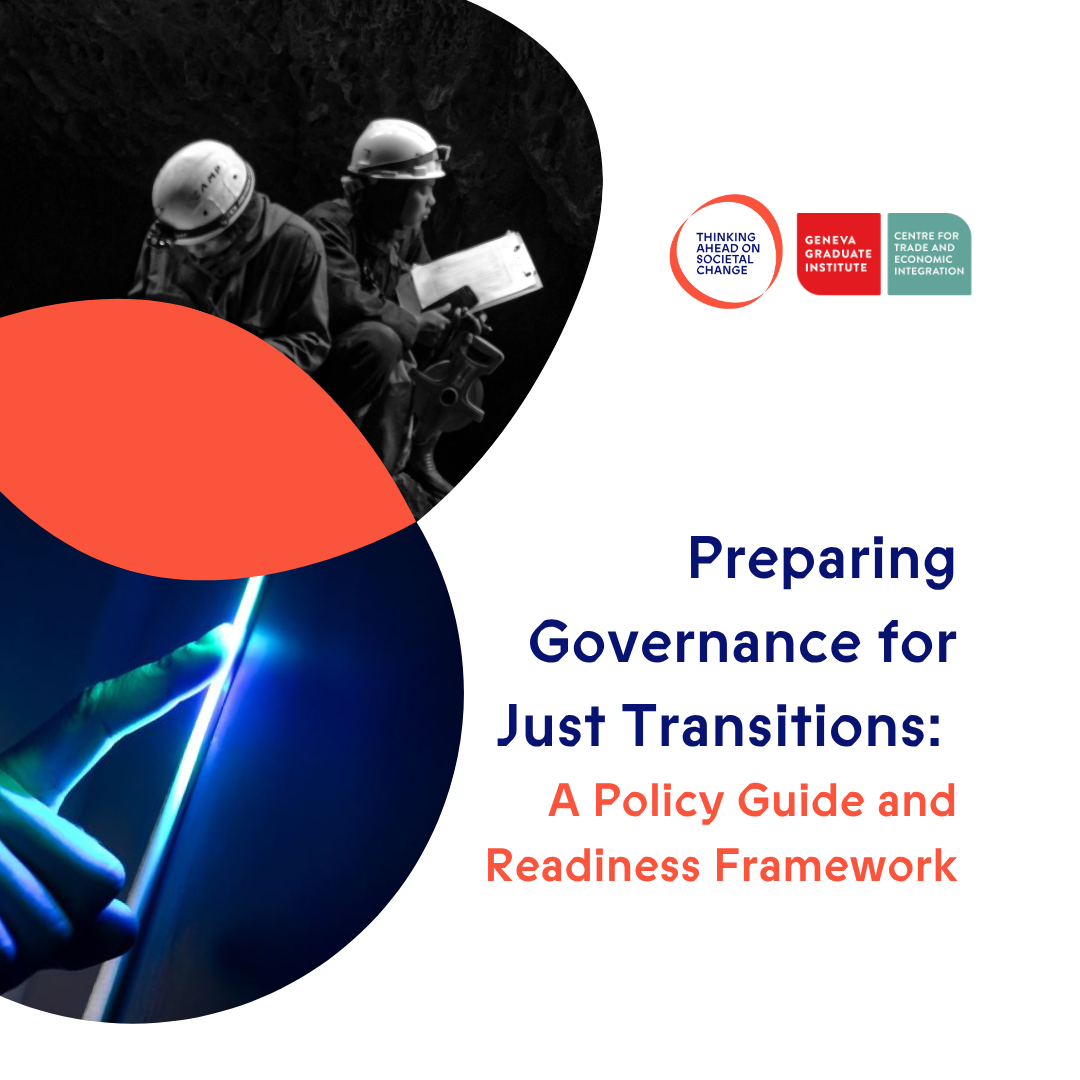
The Geneva Graduate Institute’s commitment to the Coalition reflects its longstanding mission to connect knowledge with policy and practice, placing social justice at the centre of multilateral cooperation. Across its research centres and platforms, the Institute has put its commitment into practice through knowledge, connections, and advocacy.
The Thinking Ahead on Societal Change (TASC) Platform’s Trade and Labour Programme offers one practical example of this commitment. As Kitrhona Cerri, Executive Director of the TASC Platform, explained, its work across trade, labour, and just transitions has produced insights on policy coherence and governance readinesss through research into Kenya’s digital economy and Indonesia’s nickel value chain.
a call For Regional Engagement
For their part, the ILO Regional Offices have been building engagement with local academic networks across the globe. Their perspectives heard at the meeting reinforced the importance of connecting academic knowledge with regional priorities and practical action. For Coffi Agossou, Deputy Regional Director of the ILO Regional Office for Africa, this is the measure of research that matters:

Prof. Thulisile “Thuli” Madonsela, Director of the Centre for Social Justice, Kitrhona Cerri, Executive Director of the TASC Platform, and Coffi Agossou, Deputy Regional Director of the ILO Regional Office for Africa.“Research has limited value if it remains on a shelf or within an academic journal. The real question is whether that knowledge can help improve a policy, strengthen an institution or change people’s lives.”
Ana Virginia Moreira, Regional Director of the ILO Regional Office for Latin America and the Caribbean, placed academic institutions at the centre of the region’s growing momentum:
“Academia should not just be a category of Coalition partners. It should become one of its engines of knowledge, innovation and critical thinking.”
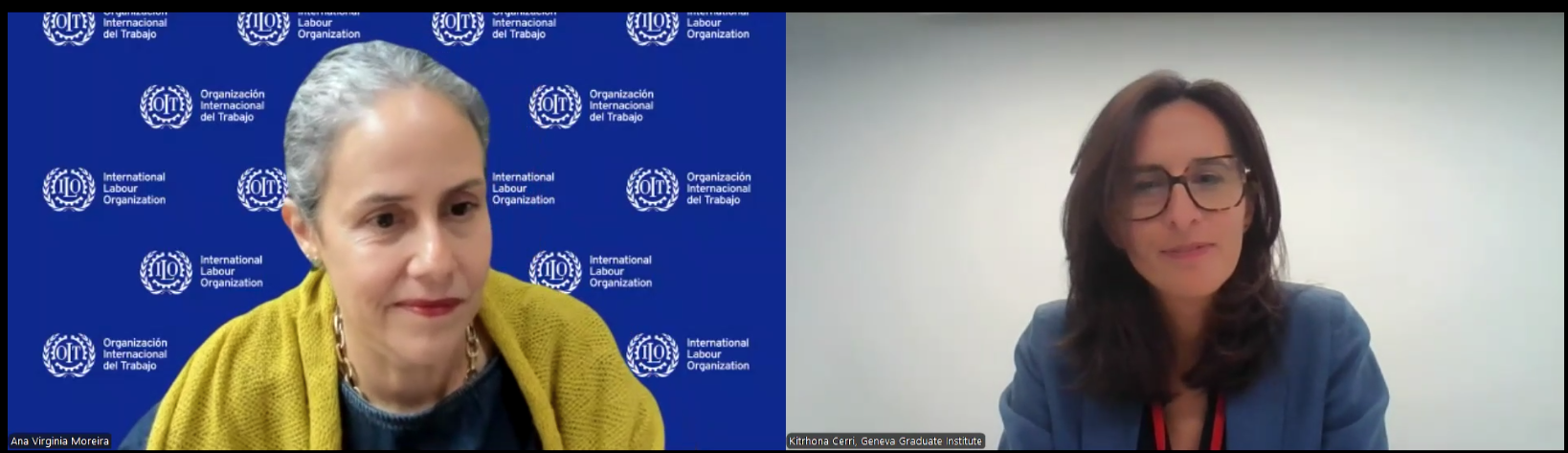
Ana Virginia Moreira, Regional Director of the ILO Regional Office for Latin America and the Caribbean and Kitrhona Cerri, Executive Director of the TASC PlatformMoving Forward Together
Across the lively discussion that followed, three shared priorities emerged:
supporting local, youth, women’s and Indigenous knowledge and perspectives, not only in research, but in shaping agendas
embedding social justice in teaching to equip the next generation of practitioners, and
engaging with policymakers to bring evidence and decision-making closer together.
On 16–17 September, the 2026 Annual Forum of the Global Coalition for Social Justice will bring the Coalition’s wider partnership together to share experience, assess progress, identify opportunities for collaboration and shape future collective action.
Tune in live as partners share experiences, assess progress, identify opportunities for collaboration and shape future collective action.
The TASC Platform has been proud to support the Geneva Graduate Institute’s contribution to the Global Coalition for Social Justice since it’s launch in 2024, convening academic partners across regions and connecting knowledge, policy and practice around shared priorities.
📬 Interested in connecting with this work? Get in touch with us.