

A new geopolitical intelligence dashboard, aims to make global trade and economic dependencies visible, providing a foundation for improved understanding of national vulnerability, leverage and readiness for transformational change.

Read on as Julian Hill-Landolt, TASC Fellow at the Geneva Graduate Institute, examines why dependency is a critical lens for both navigating fragmented global systems and revealing the conditions required for specific transformations to succeed.
To influence change in the world, it helps to understand interdependency. As social, economic and political systems have become evermore connected, grasping patterns of cause and effect at the level of scale and of complexity required to solve challenges has become increasingly difficult. To tackle this difficulty, we are building D-Dash - a transparent, evidence-based geopolitical intelligence dashboard that maps economic interdependence as the foundation for better understanding global resilience risks and transformation opportunities.
A clear view of interdependence is needed today more than ever – the decline of multilateralism and international cooperation is far from just a political challenge. Geopolitical fragmentation and mounting pressure on global institutions are reshaping the web of relationships that post-war global security and trade has relied on. Many of these relationships are under strain. Indeed, the world is undeniably more volatile than ever: The ICRC is tracking more than 130 global armed conflicts today, the highest level since World War II and a figure which has doubled over the last 15 years.
This is the context in which global, national and corporate agendas have to operate. Resources, finance, energy, food, industrial capacity and policy are connected through the global economy, forming dependencies and relationships that shape national interests, economic priorities and political choices. Whether securing supply chains, strengthening economies, navigating uncertainty, or accelerating sustainable development, effective action requires businesses, institutions and countries to make decisions that are shaped by cross-border relationships.
“D-Dash provides access to visualisations and systems-level insights currently only available to a selection of governments and multinational businesses, offering frictionless access to information that can help a fragmented world to identify mutual interdependencies, shared risks, and resilience and adaptation opportuntities”
Trade as the foundation for understanding vulnerability and leverage
Currently, the data that can help us to understand and act upon interdependencies is partial and fragmented – siloed (e.g. trade, energy, democracy), one-off, or closed. D-Dash provides a unique integration layer that joins open, dynamic data streams to both visualise the data, and generate findings that organisations can act on. Who depends on whom, for what, how much, and with what consequence – revealed by linking dependence, vulnerability and leverage together, and connecting them to each country’s fragility, strength and capacity to adapt and change.
D-Dash does this by mapping global trade across 69 economies and the European Union, with additional exposure analysis for 30 strategic commodities, from crude oil and natural gas to fertilisers, steel and critical minerals. The current dataset, sourced from UN Comtrade, comprises eight million raw trade data points and over 2,000 individual commodity exposure analyses.
A map-based interface allows easy exploration of countries’ trading partners, key commodities and dependence on particular resources, providing a common country-level starting point for deeper analysis.
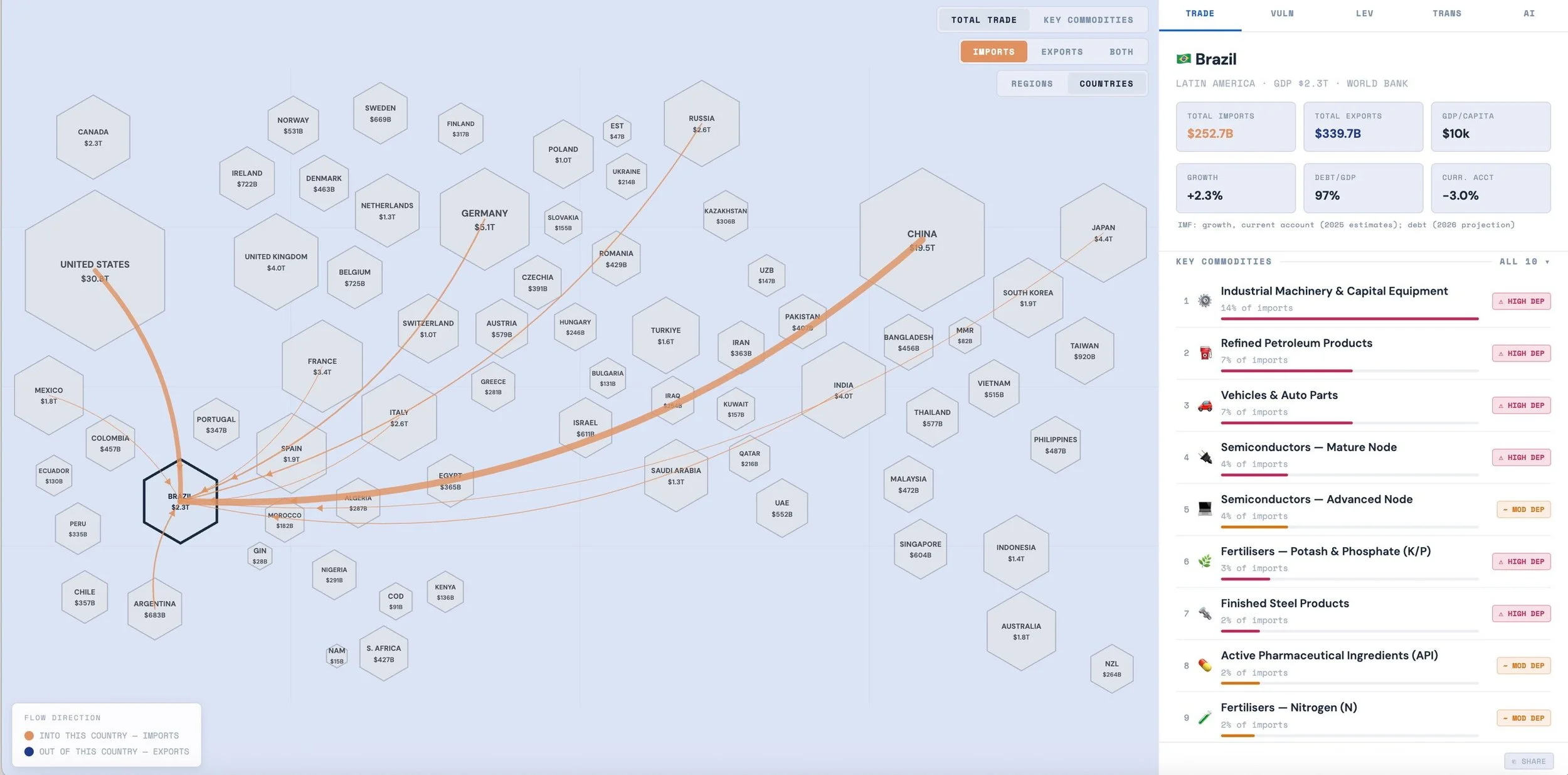
Country trade profile example: Brazil, its top trading partners, and the strategic commodities it is most dependent on.
The trade layer is connected with additional open and dynamic data sources, enabling systems-analysis layers for energy, food, and resource security, and fiscal, political, technological, societal and environmental risk. Combining a country’s trade and dependencies with its broader vulnerabilities can help identify sources of leverage and opportunities for action.
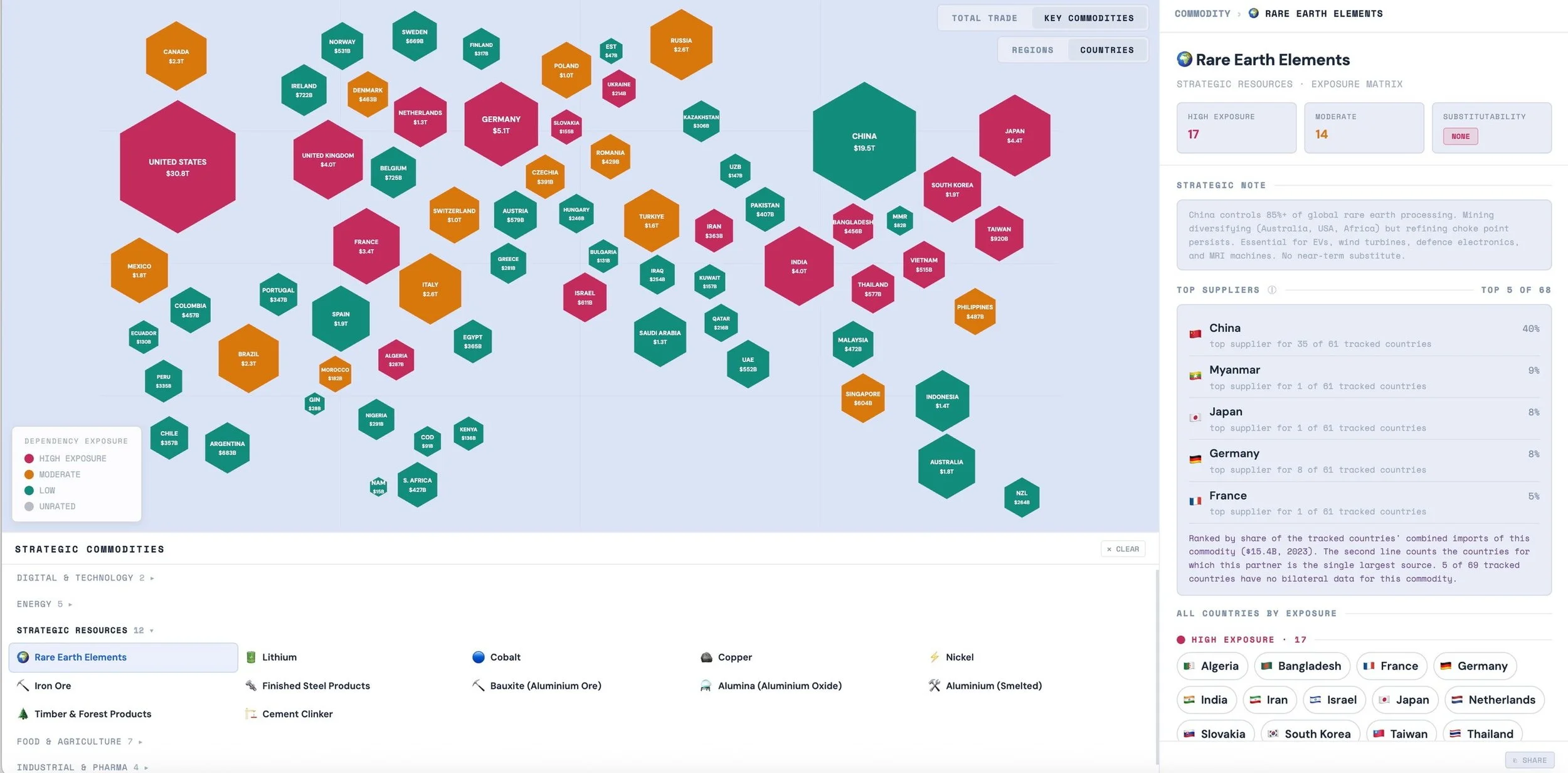
Commodity exposure view: which countries are most dependent on supply, how substitutable is the commodity, and who are the top global suppliers.
From understanding trade to informing transformations
Connecting the various analytical layers enables deeper exploration of where dependencies are concentrated, how they intersect with other pressures, and how changes in one part of a system may affect others. Supply constraints can affect industrial strategy; financial exposure can limit the pace of a transition; and policy choices may depend on access to materials, energy or trading partners. Understanding these connections helps explain not only what is happening, but why certain options are available, difficult or unlikely to succeed.
This is particularly relevant to sustainable transformation. Identifying where an intervention could have the greatest effect requires understanding the system it is intended to change.
Which dependencies create bottlenecks?
Where could changes in resources, investment or policy unlock wider progress?
What vulnerabilities must be addressed before a solution can succeed?
A clearer picture of trade and interdependence can help answer these questions, identifying potential points of intervention and revealing essential preconditions that might otherwise be overlooked.
Sustainability, however, is only one application amongst many. The tool’s foundation can inform economic development, industrial policy, resource security and geopolitical analysis. It improves the starting point from which global partnerships and transformational challenges can be understood and addressed.
Strengthening complexity-constrained decision making
The D-Dash tool tests a simple premise: to understand the possibilities for policy, investment and strategic action, we need to understand the dependencies that shape priorities and choices.
Global trade provides an essential foundation for that understanding, connecting countries through flows of goods and strategic resources. Linking this foundation to other domains can help reveal how a deeper, systemic understanding of dependency, vulnerability and opportunity can support societal resilience and longer-term sustainable transformation.
The wider value lies in understanding readiness: how dependency connects to a country’s fragility, strength and capacity to adapt and change, where choices are constrained, and where policy, investment and other enabling conditions need to shift for change to succeed.
Interested in learning more? We are currently building out the governmental, corporate, NGO, academic and philanthropic partnerships that will support the ongoing development and implementation of D-Dash. Read the full product vision, and contact us for further information.