

If AI Had An Off Switch, Would You Use it?
From data work to AI supply chains: reflections from THE 9th annual conference of the International Network on Digital Labour

In this reflection on the closing roundtable of INDL-9, Uma Rani, Senior Economist in the ILO’s Research Department examines what a wider view of labour in AI supply chains concretely means.
Read on and explore the questions research is currently asking, evidence policymakers need, and where policy can intervene to strengthen AI governance and shape the future of work.
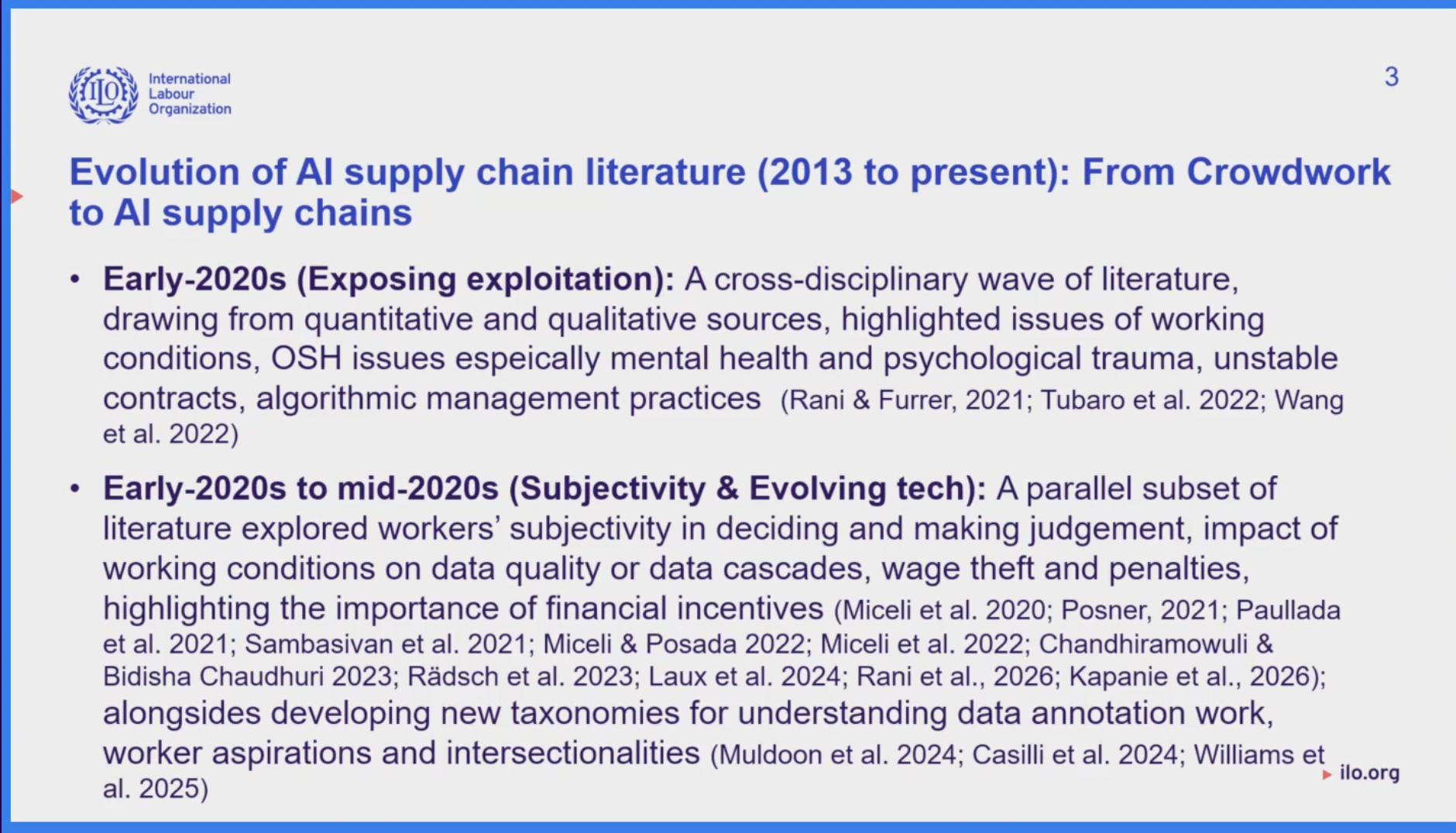
Tracing more than a decade of research across disciplines, the field has expanded from early studies of micro-task work and crowdwork, rooted in human-computer interaction (HCI), through working conditions, data quality and algorithmic management, to the human labour underpinning AI systems and today’s efforts to map the entire AI supply chain.
That widening lens builds on the ILO’s longer work on the Future of Work. The ILO Centenary Declaration for the Future of Work placed a human-centred approach at the heart of technological change, with platform work and algorithmic management already part of the conversation. AI supply chains were not part of that framing at the time.
The ILO’s work on digital labour platforms demonstrates what sustained evidence-building can achieve. Legal research on platform workers was emerging around 2010–11; the ILO began surveys in 2015 and progressively built country-level and global evidence. In 2026, that longer trajectory contributed to the adoption of the Decent Work in the Platform Economy Convention, 2026 (No. 193).
This specific research-to-policy trajectory takes on new urgency as technological change accelerates in speed and scale.
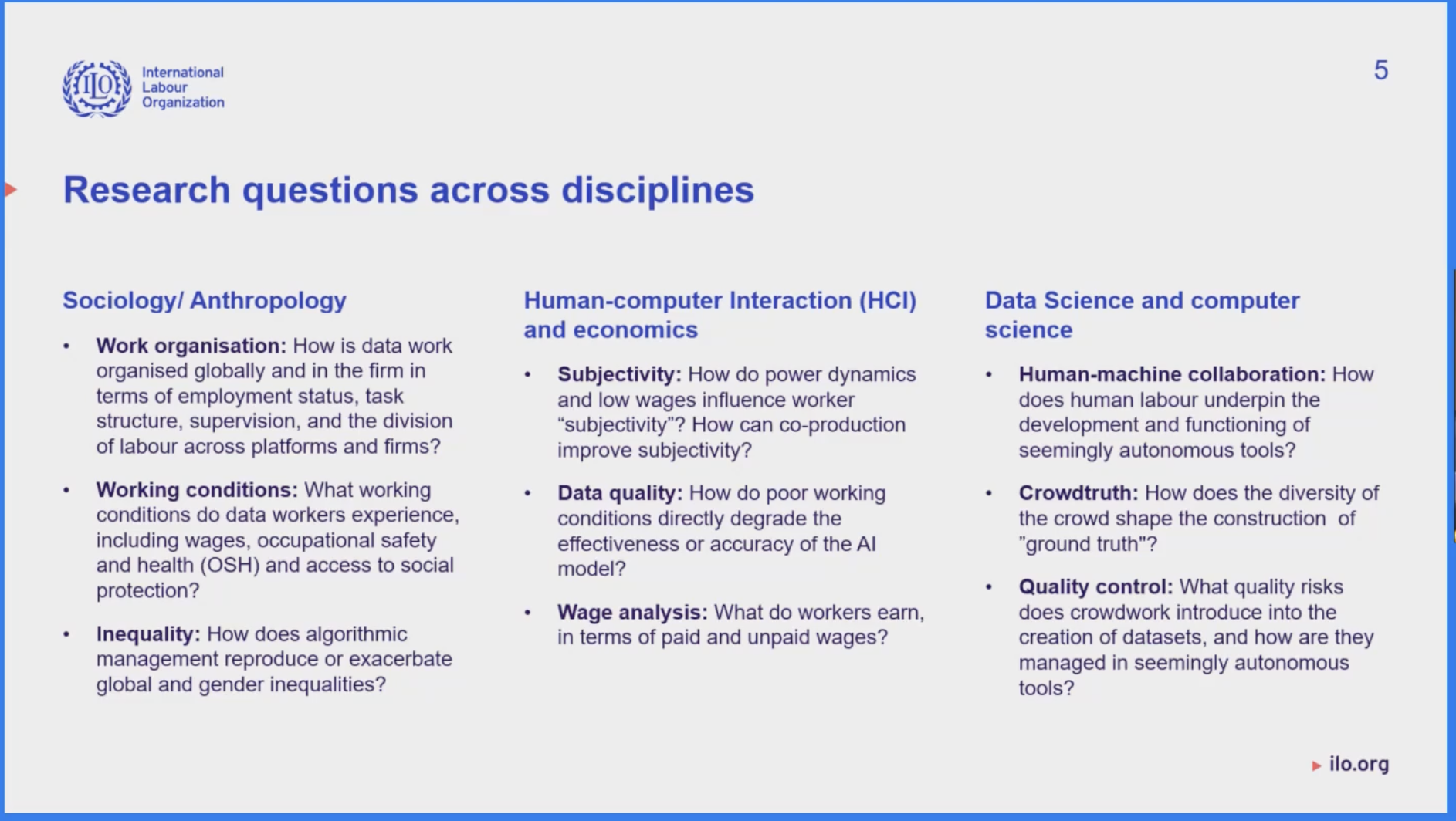
What research
is needed
now,
and what do
we want to
use it for?
Drawing on the discussions and research presented over three days, the roundtable offered an opportunity to reflect on the key issues emerging from INDL-9 and on future directions for research and policy on AI, digital labour and AI supply chains with:
Alex Taylor (University of Edinburgh) on expanding the unit of analysis and challenging dominant narratives, Paola Tubaro (CNRS) on the changing nature of AI work, and Tim Newman (TechEquity) on power and leverage across AI supply chains.
AI, investments and concentration
The thought experiment of an AI “off switch”, introduced by Alex Taylor, Reader in Design Informatics at the University of Edinburgh, prompted around a third of the audience to raise their hands in acknowledgement that they would flip the switch, reflecting broader concerns about the trajectory of AI development and its impact on society.
“AI is a political economy that serves various actors, and concentrates wealth in very particular geographies and amongst very particular people.”
Arguing that AI currently absorbs enormous financial resources, Taylor highlighted how wealth and power are concentrated in the hands of a few corporations, with this profit drive relying on promised future opportunities and productivity gains that remain unproven.
Citing healthcare as the “canonical” response when the value of AI is questioned, he and Uma Rani turned the argument back to where resources are directed: what might comparable levels of investment achieve if channelled directly into healthcare systems, quality jobs and local infrastructure instead, helping to strengthen local communities and support broader structural transformation?
keeping pace with ai work transformation
Many AI tools are still largely experimental and the productivity boom promised half a decade ago has yet to materialise.
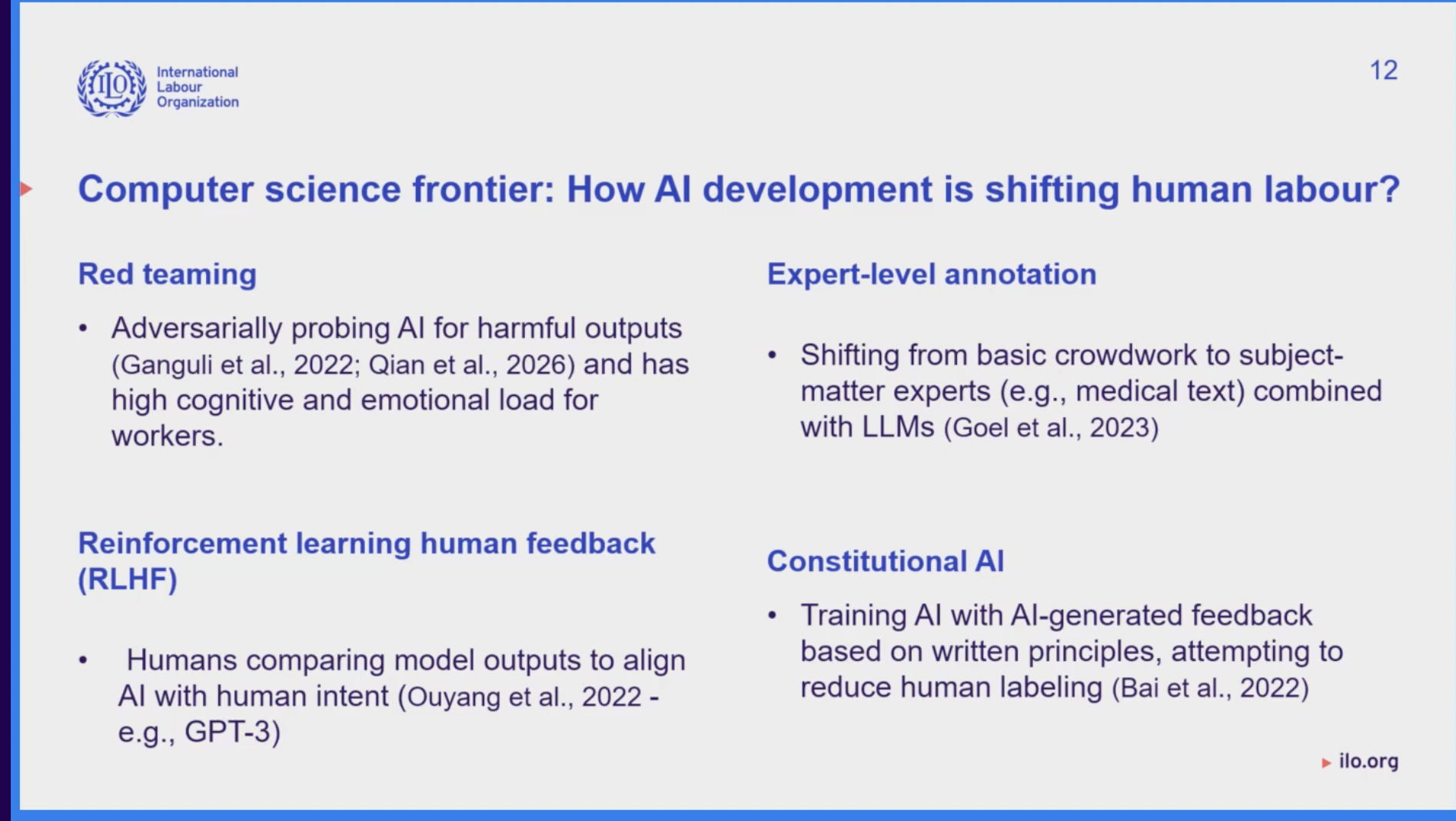
Paola Tubaro, Research Professor at CNRS, noted that as AI evolves, so too does the nature of the work underpinning it. The rise of large language models, for example, has created new forms of work through reinforcement learning from human feedback (RLHF), where workers rank outputs and write prompts to make models sound more human. These tasks require evolving sets of skills and expertise from workers, and this process needs to be documented.
Supply chain mapping
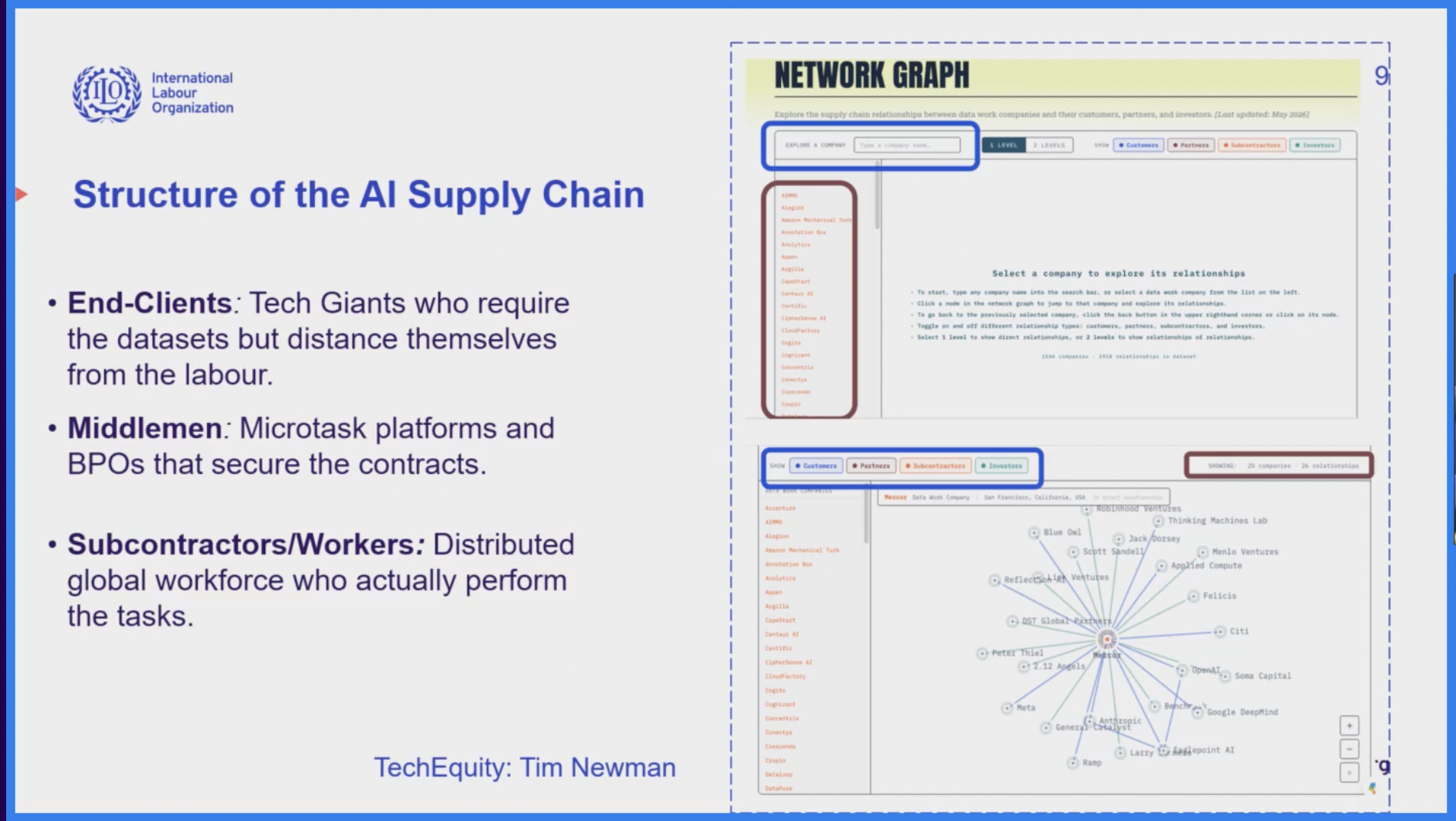
Tim Newman, Senior Vice President of Labor Programs at TechEquity, suggested focusing on the political economy of AI, specifically by making a business case for labour rights. By identifying weaknesses in AI companies’ business models, researchers can frame labour interventions in terms that these companies understand.
He also called for a collaborative supply chain mapping exercise, arguing that researchers should go beyond tracing relationships between companies.
“We should work towards a shared power mapping exercise” exposing how AI business models function, where they are vulnerable, and where strategic interventions may be possible.”
Public procurement emerged as one such pressure point. Newman drew on the US anti-sweatshop movement, where academic institutions were pushed to set labour standards for the apparel they purchased. As universities and public institutions become major consumers of AI, they may hold similar leverage through the standards attached to their contracts.
Opportunities for collective action

Across the discussion, one priority kept resurfacing: making the human labour behind AI visible, as we need “to tell the counter stories”, according to Alex Taylor. Researchers can help counter prevailing narratives by making data work more transparent and building evidence across different geographies that shows this work is systemic rather than incidental.
Speaking from the floor, Antonio Casilli, Professor, Institut Polytechnique de Paris, also cautioned against narratives shared in the media suggesting that synthetic data will make human labour obsolete and discrediting the validity of AI supply chain research, reinforcing the need to keep documenting the people and work behind AI systems.
While there is already an established literature on data work, the research community now needs to work more collaboratively to strengthen the evidence base. The ILO is planning a repository to centralise interdisciplinary research on AI supply chains, helping researchers share findings, identify gaps and coordinate their efforts. Collaborative surveys, combined datasets and longitudinal research could further strengthen that evidence across geographies and over time.
“When the same findings emerge from different contexts and methods, the evidence becomes much harder to dismiss as anecdotal.”
Moving forward
The discussion pointed to practical sources of leverage. Public procurement, labour standards attached to institutional contracts and legal protections can all create pressure points across complex AI supply chains. The panel drew on the Bangladesh Accord as a precedent for extending accountability across supply chains, rather than leaving responsibility with individual suppliers alone.
While the power of AI companies may seem overwhelming, the INDL-9 conference demonstrated that they are not invincible. When data workers, researchers, activists and policymakers align, they can challenge prevailing narratives, craft new strategies, and build the collective power necessary to hold AI companies accountable
The road ahead is long, but as the conference showed, there is a growing global community willing to take up this challenge, building the evidence, widening the research community and connecting insights across disciplines and regions to strengthen visibility, accountability and more informed choices about the future of work.

The ninth annual conference of the International Network on Digital Labour (INDL) took place from 9–11 September 2026 at the International Labour Organization (ILO) headquarters in Geneva. Under the theme “AI Supply Chains: Building an interdisciplinary research agenda for AI and labour,” nearly 200 participants came together to examine the people, processes and working conditions underpinning AI development and deployment.
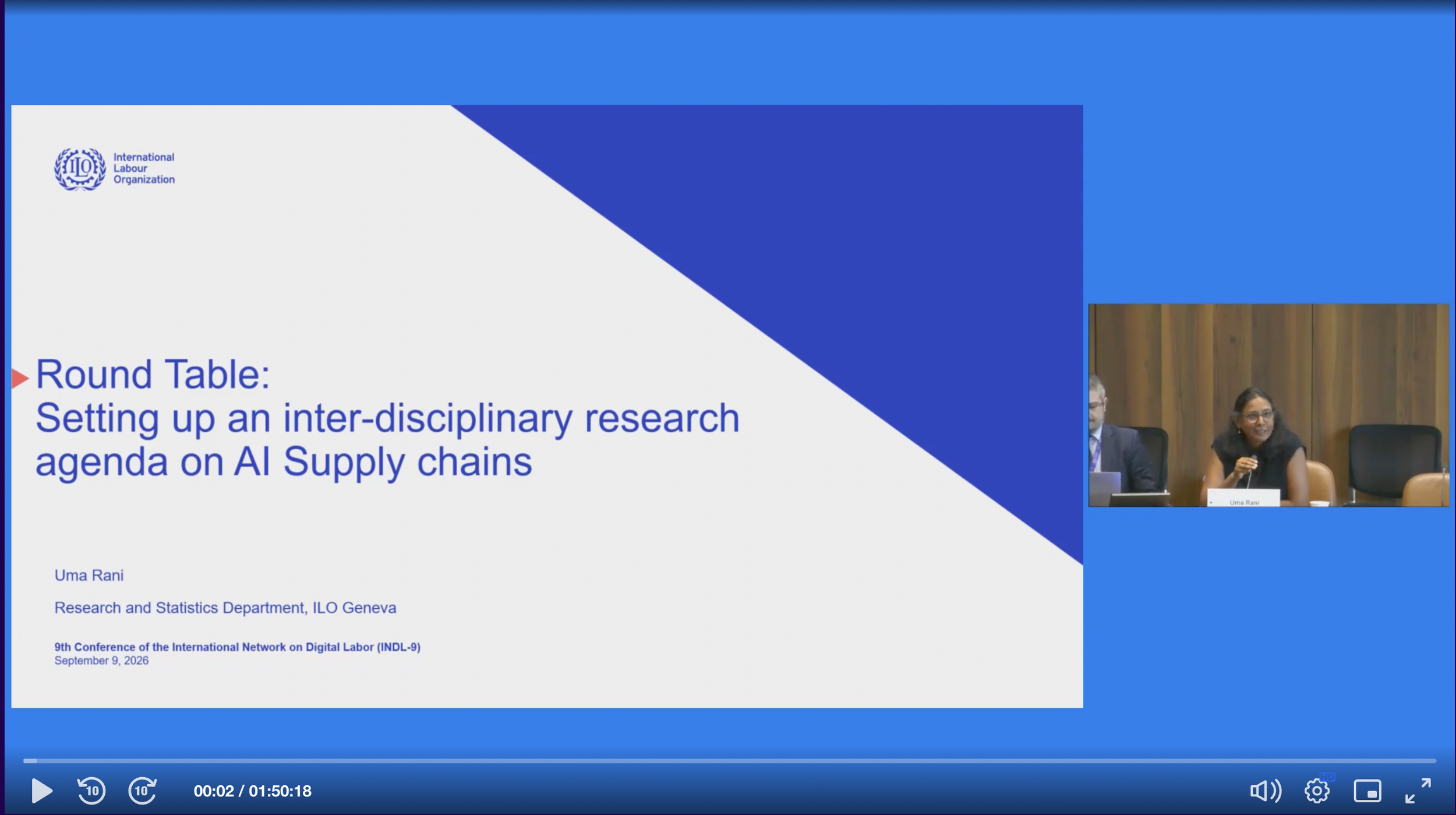
9th Annual Conference of the International Network on Digital Labour (INDL-9) Closing Round Table
Founded in 2019, INDL connects researchers, data workers, activists and others across academia and civil society. Its growing regional network includes INDL Middle East and Africa, INDL North America, INDL Latin America and INDL South Asia, supporting research and exchange across different geographies and experiences of digital labour. INDL-10 will take place in São Paulo in September 2027.
The programme included keynote addresses from Julian Posada, Julie Yujie Chen and Alex Taylor. INDL-9was organized through a collaborative partnership between the ILO, the TASC Platform of the Geneva Graduate Institute’s Centre for Trade and Economic Integration, DiPLab, ACM SIGCAS and Yale University.