

Stop Saying “Trade and Labour”
In her intervention to the Geneva Dialogue on Trade and Labour, held during Geneva Trade Week 2026 as part of the WTO Public Forum, Desirée LeClercq, Associate Professor and Faculty Co-Director of the Dean Rusk International Law Centre at the University of Georgia School of Law, challenges the conventional history of trade “and” labour policy. Revisiting the Havana Charter, and the proposed International Trade Organization, she brings an often overlooked history back into view: labour was not conceived as separate from trade policy, but as part of the original trade architecture, with safeguards against protectionist abuse.
Read on as Désirée LeClercq traces how labour became separated from mainstream trade policy, and why recovering that history matters for today’s debate.
This article forms part of TASC Platform’s Geneva Dialogue on Trade and Labour blog series, drawing out perspectives, insights and research shared during the 2026 Dialogue at the WTO Public Forum.
The phrase “trade and labour,” along with its trendy cousin, “flanking,” signals that labour standards belong in trade policy. What it reaffirms, instead, is that trade can operate, and be conceived, without the labour that renders trade possible. It suggests that labour standards and the provisions that house them are optional.

“We have absorbed this vernacular in our own conceptualization of labour standards in trade and, worse still, our telling of its history. That history, and its lessons for modern trade policy, desperately need correction.”
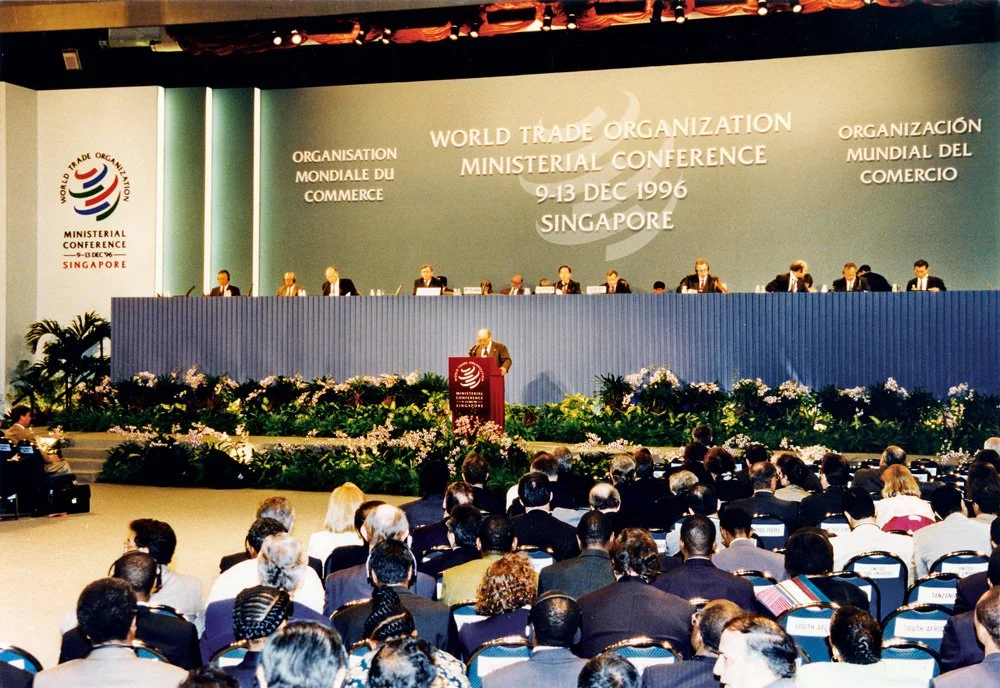
December 1996 — Director-General Renato Ruggiero addressing the First Ministerial Conference in Singapore.
When worker-rights and trade policy scholars describe the history of labour rights in trade policy, their account normally begins in 1996. At the World Trade Organization (WTO) Singapore Ministerial, the developing-country Members defied the Clinton Administration’s push to bring a “social clause” into the WTO and punted the question to the International Labour Organization.
In 1998, the same developing countries blocked the trade-labour link again and compromised with the adoption of the ILO’s Declaration on Fundamental Principles and Rights at Work, which committed the ILO’s Members to the Organization’s fundamental labour rights and declared that labour standards could not be used for protectionist purposes.
Untethered from historical anchoring, the 1990s paint a clear picture. Rules regarding trade and labour had proceeded along separate tracks since the 1940s, seemingly confirming their independence. By the 1990s, developing countries suspected that larger economies, such as the United States, would weaponize labour standards for protectionist ends, and some objected to diminishing their own comparative advantage in labour costs when countries like the United States faced no such impediments while developing.
The vernacular and the history on which it is based are self-reinforcing.
“But the debate on regulating labour standards in trade did not spring, like Athena, fully formed and armed. It was the product of decades of failed negotiations and false assumptions. The real story is that labour was accidentally removed from mainstream trade policy, and it is time we put it back in.”
In a forthcoming contribution to International Economic Law and Human Rights, a volume edited by Holger Hestermeyer and Clara Lopez as part of the Edward Elgar Research Handbook series, I reproduce the original debates over the International Trade Organization (ITO) in the 1940s. This part of the story is missing from the traditional 1990s account.
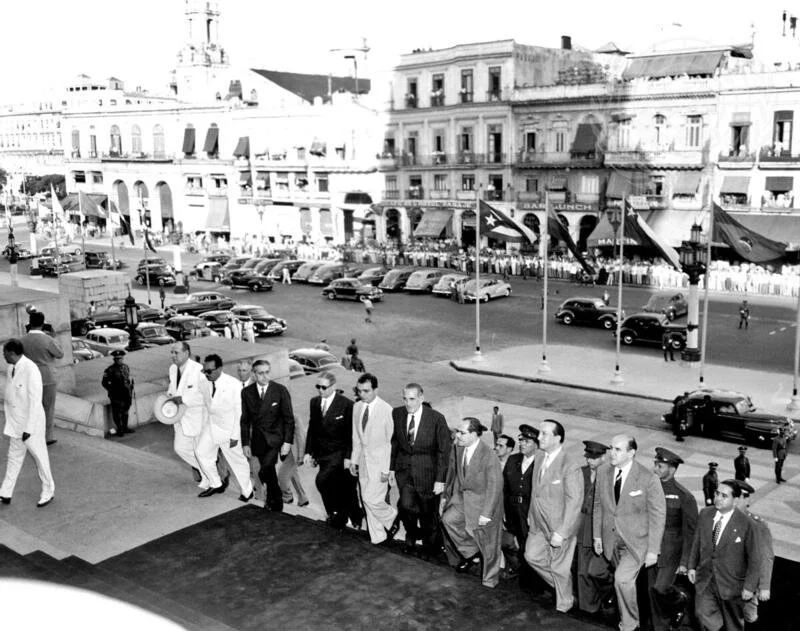
21 November 1947: Delegates arriving for the inaugural meeting of the United Nations Conference on Trade and Employment in Havana's Capitolio. The purpose of the Conference, attended by representatives of more than 60 countries, including 51 Member States of the United Nations, was to establish the proposed International Trade Organization (I.T.O.).
Developing countries were the demandeurs of the Fair Labour Standards clause, housed in Article 7 of the Havana Charter. That clause would have ensured that global production did not increase at the expense of fair labour standards. It also envisioned intricate enforcement machinery, in which the ITO and ILO could operate in tandem (memorialized in a formal memorandum of understanding between the two institutions) to vet retaliatory measures before trade partners could impose sanctions. Fair labour standards were embodied in the trade architecture; they did not flank or follow the principal trade rules. The drafters sought to ensure that two institutions would stand guard against protectionist abuse.
When the Havana Charter fell in 1950, the negotiators wrongly assumed that its chapter laying out employment objectives and fair labour standards would carry over into the General Agreement on Tariffs and Trade (GATT). So confident were they of continuity that they deemed further negotiations to incorporate it superfluous.
In the 1950s, the United States and other governments began inserting fair labour standards clauses into international commodity agreements, this time without institutional oversight.
“In place of two organizations vetting an alleged violation, self-interested trade partners became the sole enforcers. ”
Unsurprisingly, the developing countries that once championed an institutional architecture to protect labour in trade became suspicious, reticent, and, ultimately, defiant. Their defiance now opens the story of trade and labour and paints developing countries as normatively opposed to workers’ rights in trade. But today’s “trade and labour” chapters that “flank” trade policy confirm concerns, expressed consistently since the 1940s, that unilateral enforcement without an institutional check invites protectionism.
The starkest case of unilateral enforcement without an institutional check came in June 2026, when President Trump opened a Section 301 investigation of 60 economies for failing to adopt and enforce forced-labour import bans, then imposed tariffs of 10 to 12.5 percent on all 60. Trade policy analysts and worker-rights advocates both objected that the measures lacked legitimacy and were designed to protect U.S. domestic business from competitors abroad. The Administration’s answer, like the Biden Administration’s before it, invokes the vernacular. By adopting a “worker-centered” trade policy, the United States casts itself as an altruistic actor that voluntarily cedes its trade policy to workers’ rights, and it asks for the benefit of the doubt in return. But by making the sole determination regarding retaliatory sanctions, both administrations demand discretion over trade policy that negotiators, since the 1940s, have deemed too riddled with protectionist opportunity.
“Trade and labour. Flanking. These terms are misnomers. ”
You cannot trade without workers to harvest, stitch together, produce, manufacture, and ship global goods. The original trade architecture recognized that fact, along with the risk that trade partners would use workers as cover for protectionism, and it built an inter-institutional process to safeguard its trade regime. It is time to recognize that trade policy is labour policy.

The Trade and Labour Programme convenes stakeholders across trade and labour research, policy and practice to examine how economic transitions can deliver more just and inclusive outcomes. Through fieldwork, multistakeholder dialogue, and policy engagement, the programme is building momentum for a global trade system that is socially responsive, economically resilient, and fit for the future of work, and the future of working together.
📬 Interested in joining this dialogue? Get in touch with us.