

Labour Provisions in Trade Agreements: From Commitments to Decent work
In her intervention to the Geneva Dialogue on Trade and Labour, held during Geneva Trade Week 2026 as part of the WTO Public Forum, Marva Corley-Coulibaly, Senior Economist at the International Labour Organization (ILO), examines the growing role of labour provisions in trade agreements. She looks beyond their inclusion on paper to the policies, institutions and stakeholder engagement needed to translate trade opportunities into better jobs and decent work.
Read on as Marva Corley-Coulibaly explores what it takes to turn labour commitments in trade agreements into meaningful outcomes in practice.
This article forms part of TASC Platform’s Geneva Dialogue on Trade and Labour blog series, drawing out perspectives, insights and research shared during the 2026 Dialogue at the WTO Public Forum.
The ILO is actively engaged in trade and labour issues and particularly on labour provisions in trade agreements, and I would like to share a few perspectives from that work.
1. Labour provisions are an established feature of trade agreements
Starting with a broader picture
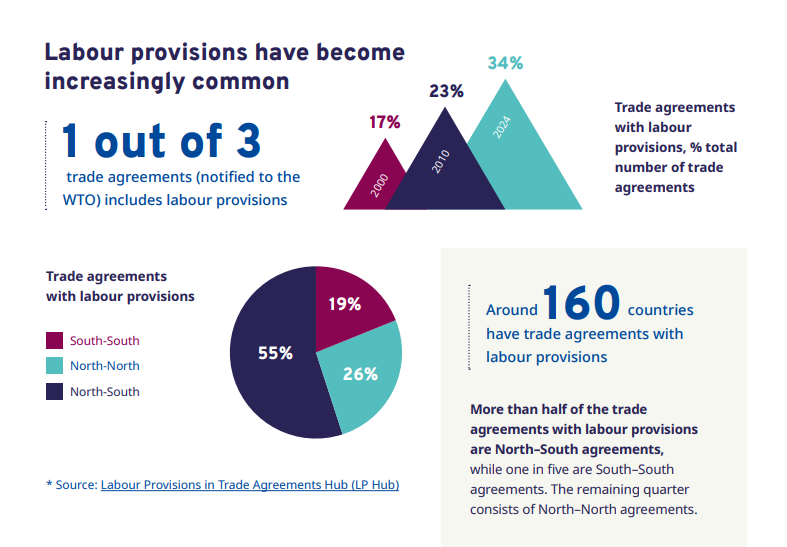
Labour provisions have moved from being relatively uncommon to becoming an established feature of trade agreements. Today, around one in three trade agreements notified to the WTO includes labour provisions — and the share is considerably higher among agreements concluded more recently.
Across this landscape, there are different models, which vary in their commitments and approaches to cooperation, monitoring and compliance. But there are also some common features worth highlighting.
First, stakeholder engagement is increasingly embedded in the institutional architecture of these agreements. Nearly nine in ten trade agreements with labour provisions establish at least one formal stakeholder-engagement mechanism — such as an advisory group, contact point or committee.
Second, there is an important common reference point for labour commitments. Around 70 per cent refer to the ILO Fundamental Principles and Rights at Work: freedom of association and the effective recognition of the right to collective bargaining; the elimination of forced labour; the abolition of child labour; the elimination of discrimination; and a safe and healthy working environment.
Importantly, these principles are not created by trade agreements. They reflect principles and commitments already agreed by ILO member States through our tripartite structure.
“But including labour provisions in an agreement is one thing. The next question is implementation—how is this translating into decent work.”
2. TUrning trade opportunities into more and better jobs
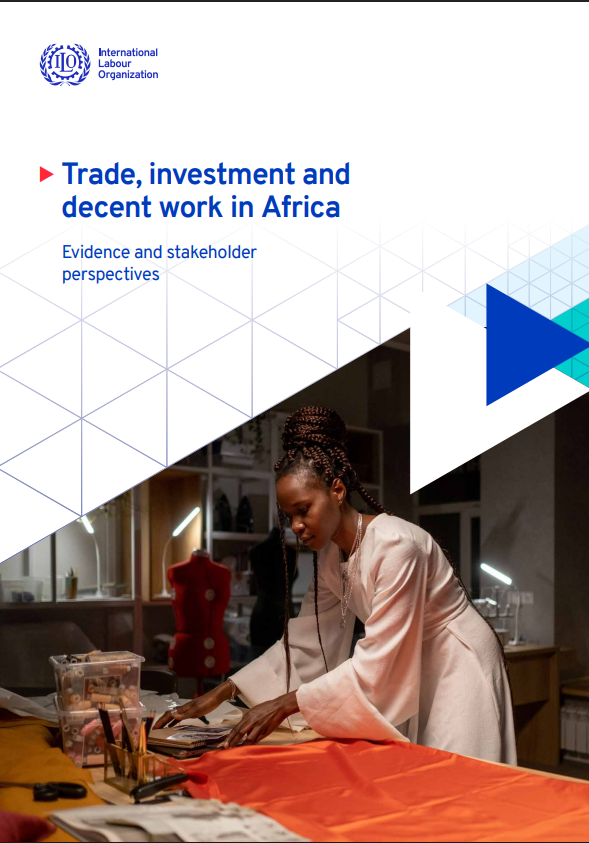
Recently, the ILO undertook stakeholder (tripartite +) surveys and dialogue activities on trade and labour issues across five African countries. We asked about perspectives of trade and labour issues more generally, but also about implementation of labour provisions. The findings from this engagement were just released in a report on Monday, 15 September 2026, entitled: Trade, Investment and Decent Work in Africa.
The report shows that across stakeholder groups, international trade is clearly seen as a source of opportunity — particularly for employment creation, skills development and access to new markets and technology and productivity growth. At the same time, stakeholders identify challenges around limited employment opportunities — particularly as related to skills mismatches, and job quality (wages and informality). This reinforced an important distinction: trade can create employment and enterprise opportunities, but these do not automatically lead to better jobs.
This is where domestic policies and institutions matter.
When asked about the most effective policies for inclusive trade, stakeholders had similar priorities: importance of employment policies, social protection, and education and training policies. Trade policies themselves were also a priority, with labour provisions are seen as mechanism to improve framework conditions for decent work and strengthen decent work.
“There are considerable challenges to implementation: resources, transparency and barriers to stakeholder engagement including in the informal economy where a large majority of workers preside in Africa.
So what is the ILO doing to support this in practice?”
3. ILO SUPPORT FOR LABOUR PROVISIONS IN PRACTICE
I would like to highlight three complementary areas.
1. The first is international labour standards and technical expertise.
The ILO provides advice on these standards and supports member States in their effective implementation. This can complement mechanisms that countries themselves have chosen to establish through labour provisions in trade agreements.
2. The second area is evidence and policy coherence.
The ILO develops research and practical tools on trade and labour issues. Two edited volumes on integrating trade and decent work include contributions from UNCTAD and WTO, and we have recently started a What Works and Why? Series. We also developed the Labour Provisions in Trade Agreements Hub, which brings together texts on more than 100 trade agreements that include labour provisions.
3. And third is capacity development and social dialogue.
Like I said earlier, nearly 9 in 10 trade agreements with labour provisions now create some formal opportunity for stakeholder engagement. But creating a mechanism does not automatically produce meaningful engagement. Government ministries (both labour and trade ministries), employers’ and workers’ representatives need the knowledge, institutional capacity and opportunity to participate effectively.
This is part of what we are doing through initiatives such as the IMPLEMENT project - with the support of the Flanders Government of Belgium - strengthening the capacity of tripartite stakeholders to engage on trade policy and supporting dialogue and cooperation around trade and decent work.

The Trade and Labour Programme convenes stakeholders across trade and labour research, policy and practice to examine how economic transitions can deliver more just and inclusive outcomes. Through fieldwork, multistakeholder dialogue, and policy engagement, the programme is building momentum for a global trade system that is socially responsive, economically resilient, and fit for the future of work, and the future of working together.
📬 Interested in joining this dialogue? Get in touch with us.