

Governing Transitions Through Policy Coherence
In her intervention to the Geneva Dialogue on Trade and Labour, held during Geneva Trade Week 2026 as part of the WTO Public Forum, Maria Mexi, Senior Advisor, Labour and Social Policy, TASC Platform, Geneva Graduate Institute, draws on three years of research to examine a central governance question: how can institutions keep pace with economic transformation so that transitions are just?
Drawing on research from Kenya’s digital economy and Indonesia’s nickel value chain, she explores why policy coherence between trade strategies and labour governance matters, and why the timing of institutional adaptation can have direct consequences for workers.
Read on as Maria Mexi examines what the research reveals about policy coherence, sequencing and the governance capacity needed to manage economic transformation.
This article forms part of TASC Platform’s Geneva Dialogue on Trade and Labour blog series, drawing out perspectives, insights and research shared during the 2026 Dialogue at the WTO Public Forum.
the trade and labour programme
The Programme, a joint initiative of the TASC Platform at the Geneva Graduate Institute and the World Economic Forum’s Trade and Investment team, examined how trade and labour market policies can better support just transitions through cross-cutting analysis and case-based research on Kenya’s digital economy and Indonesia’s nickel value chain.
While the countries, sectors and transition pathways differed, both cases revealed similar governance pressures, suggesting that the underlying challenges extend beyond their specific national contexts.
Across both cases, the research points to a clear finding:
“Governance is fundamental to whether a transition is just. Policy coherence is therefore central to the design and implementation of mutually supportive trade and labour policies.”
preparing governance for just transitions
How trade policymaking and labour governance interact shapes how transitions unfold. Where they fall out of alignment, risks for workers increase.
The research points to four implications that help clarify where those risks emerge and how they can be addressed:
Policy misalignment is itself a labour risk factor. When trade and industrial strategies advance without adequate connections to labour institutions, adjustment costs can shift onto workers through precarity, informality and unsafe conditions.
Institutional capacity must develop alongside economic transformation. Rapid industrial expansion and new work models can outpace regulation, inspection and collective organisation. Delayed institutional investment can leave gaps in protection and allow insecure employment arrangements to become entrenched.
Labour considerations must enter trade decisions early. Investment and production choices shape employment arrangements, skills demand and occupational risks. Labour institutions and social partners need to influence these choices before priorities and resources are settled.
Social dialogue must be structured, predictable and informed. Workers’ and employers’ organisations need regular opportunities to influence decisions before priorities are settled, supported by adequate information and resources. Evidence from workplaces must inform policy revision as transitions unfold.
governance readiness framework
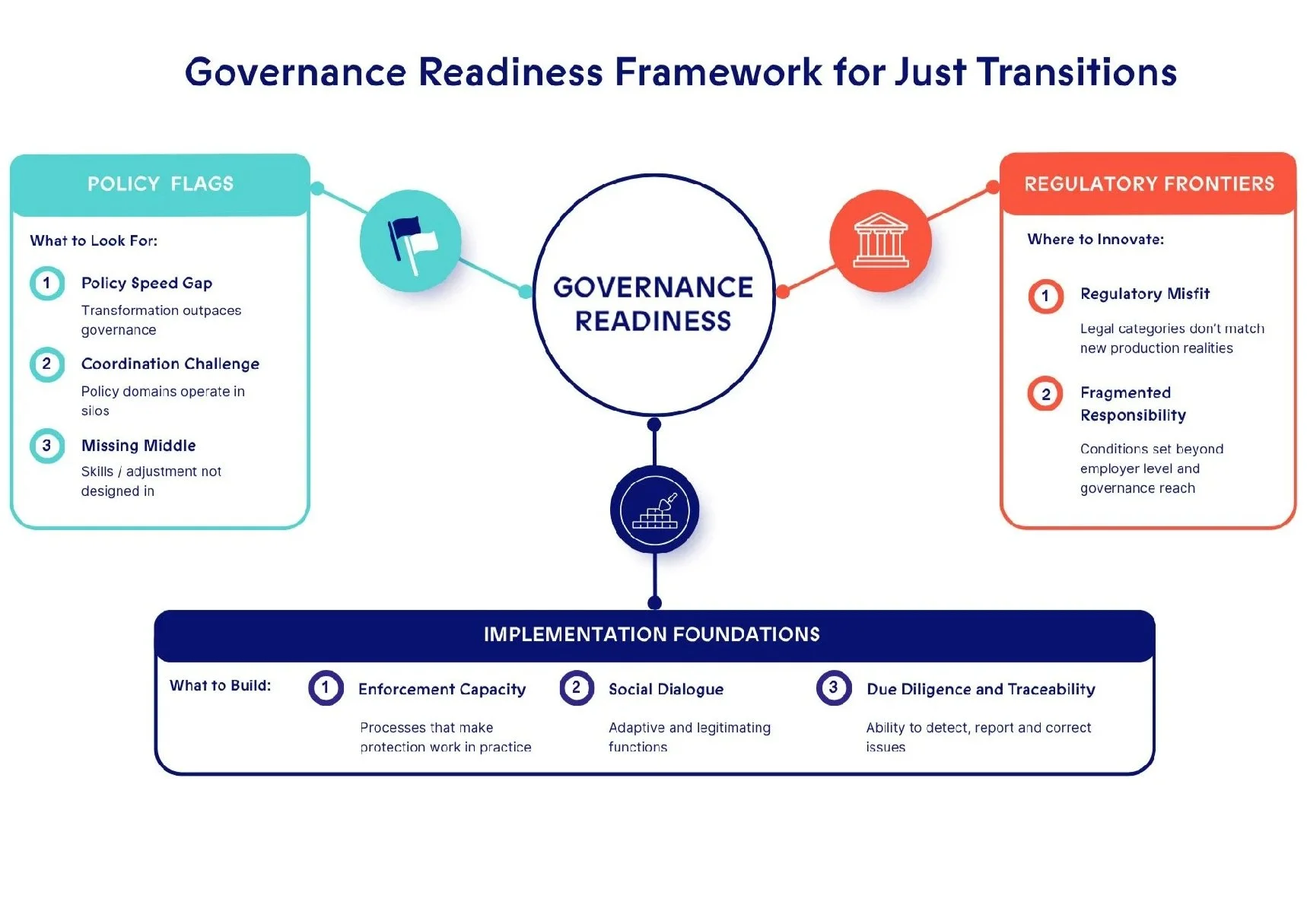
These findings are consolidated in a policy guide ‘Preparing Governance for Just Transitions. The guide reframes just transition as a governance challenge and introduces a practical Governance Readiness Framework to assess whether institutions are equipped to manage the labour consequences of economic transitions.
The framework helps identify where governance is falling short, where innovation is needed, and where institutional capacity must be strengthened as transitions unfold.
explore the wider research
Maria’s intervention draws on the findings of the Trade and Labour Programme and a forthcoming ILO Research Brief, Policy Coherence in Trade-Labour Governance, part of the ILO’s What Works and Why Series.
Together, this work takes the analysis beyond the two country cases, examining how policy coherence can be strengthened across trade and labour governance as economies navigate rapid green, digital and geopolitical transitions.

The Trade and Labour Programme convenes stakeholders across trade and labour research, policy and practice to examine how economic transitions can deliver more just and inclusive outcomes. Through fieldwork, multistakeholder dialogue, and policy engagement, the programme is building momentum for a global trade system that is socially responsive, economically resilient, and fit for the future of work, and the future of working together.
📬 Interested in joining this dialogue? Get in touch with us.