

New UNEN Paper: Progressing Beyond GDP
A new paper by the UN Economist Network, led by Richard Samans and co-authored with Chafik Ben Rouin, Tasneem Mirza, Stuart Davies, Uma Rani, and Sara Castro de Hallgren, proposes moving beyond GDP through a Multidimensional Living Standards Index (MLSI) and a new headline measure, Gross National Sustainable Development (GNSD), integrating economic output with lived experience to better guide policy on inequality, AI, climate, and inclusive growth.
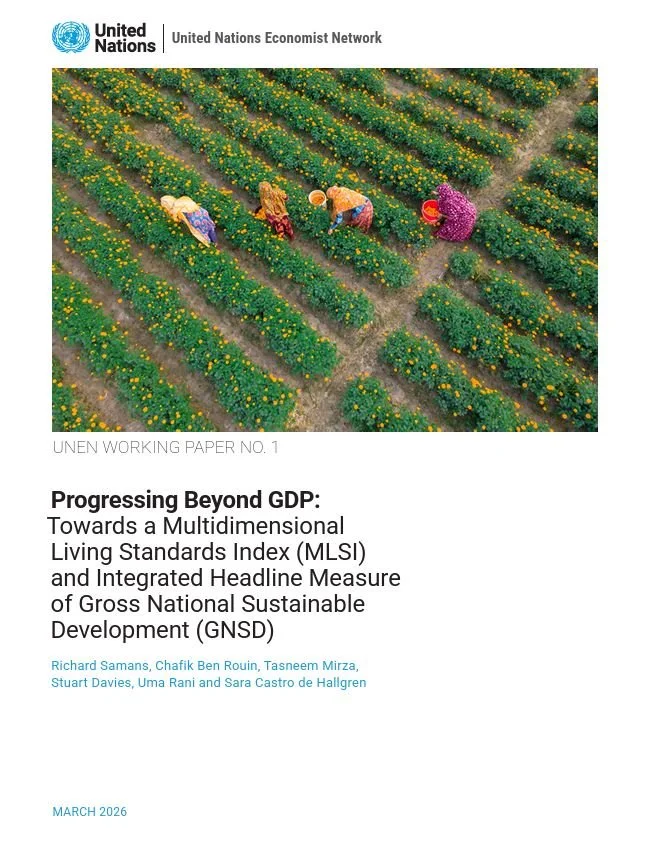
Progressing Beyond GDP: Towards a Multidimensional Living Standards Index (MLSI) and Integrated Headline Measure of Gross National Sustainable Development (GNSD)
How best to supplant or “dethrone” GDP alone as the paramount measure of national economic performance and international development standing? A new paper by a group of UN-affiliated economists makes a concrete suggestion regarding this ultimate, high-ambition purpose of "Beyond GDP" reform. It comes as intergovernmental negotiations are due to begin later in the year on this complex topic following the issuance of an upcoming report by a High-Level Expert Group.
This new UN Economist Network Working Paper, of which Geneva Graduate Institute Senior Fellow and UNEN Special Advisor Richard Samans is lead author, suggests that what could be most helpful in achieving this transformational outcome would be for governments to clearly segment the three key dimensions of this measurement challenge (productive output, material living standards and other, non-material and/or subjective markers of well-being), reporting on all three in a internationally standardized baseline fashion while encompassing the first two in a new headline measure of economic progress: Gross National Sustainable Development. GNSD would integrate the standard measure of productive output (GDP) with a new Multidimensional Living Standards Index (MLSI) that provided an internationally standardized view of economic progress from the other end of the telescope, i.e., from the perspective of the material lived experience of people (median household living standards).
The paper provides a detailed illustration of both new constructs. It is meant as a fundamental reflection, in some ways a return to first principles, on how the overall Beyond GDP endeavor might be structured to achieve maximum behavioral impact in the highest economic policymaking councils of governments and international organizations, while making far more transparent the pace of countries’ “progressive realization” of universal economic and social human rights under the International Covenant for Economic, Social and Cultural Rights signed by 170+ countries.
The paper concludes with an analysis of how such a more complete and balanced headline measure of economic progress could enable better policy debates and decisions on some of the biggest economic challenges facing countries in the 21st century. These include artificial intelligence, which is likely to increase productivity and national income but aggravate inequality other things being equal, as well as climate change, population aging and fragmentation of the international trading system. Each of the latter three appears poised in its own way to constrain the quantity of economic growth in the coming years in many countries, making it more important than ever for their governments to prioritize policies that improve the social quality of their growth, i.e., the "efficiency" by which its process and benefits are diffused widely in the material lived experience of people in the dimensions spotlighted by the new Index.

The UN Economist Network Working Group on Development and Sustainability brings together economists and practitioners advancing new approaches to measuring progress beyond GDP. Through research, dialogue, and collaboration, the community explores how economic performance, living standards, and sustainability can be better aligned to inform policy and practice.
📬 Interested in learning more or engaging with the community? Explore the page and connect with us.