

The Alignment Challenge: Reconnecting Policy at the Trade-Labour Nexus
Maria Mexi, Senior Policy Advisor, TASC Platform, Geneva Graduate Institute and Visiting Fellow, ILR Global Labour Institute, Cornell University, provides a basis for discussions at “Beyond Tariffs: Reconnecting Economic Policy with Social Development” by examining how economic transformation can either advance decent work and inclusive development—or deepen structural vulnerabilities when labour governance fails to keep pace.

I would like to begin with the event’s title: “Reconnecting economic policy with social development.”
The word reconnecting immediately raises a question.
Does it assume that there was once a coherent connection between economic policy and social development—and that today we are simply trying to repair a rupture? Or have economic and social policies ever really been coherently connected in the first place? I will leave that question here. But that question leads me to a second one: what exactly do we mean by “connection”?
Trade and economic policy frameworks have always been connected, in some way, to social outcomes. Bad economic policies produce inequality. Trade can destroy jobs—or it can create new ones. So the connection exists, at least in the sense of linkage or correlation. But do we want to leave it there, or are we actually looking for something more? When we talk about connection, a key element is alignment.
How can trade and economic policies be better aligned with social objectives and labour outcomes? That, I think, is the challenge before us. Alignment is fundamentally about policy coherence, which lies at the heart of the Doha Political Declaration.

This focus on alignment sits at the centre of our research, which looks at the trade–labour nexus, with particular attention to how it operates at the domestic level.
We began by examining labour provisions in trade agreements—one dimension of that nexus. The ILO’s trade agreements hub shows a growing incorporation of labour provisions over time. Through the Trade and Labour Programme, we have also held discussions with experts and UN missions in Geneva. A key point repeatedly raised in these discussions was this: the issue is not that economic and social objectives have not been connected on paper.
The challenge lies in how this connection operates in practice, especially in domestic implementation. In other words, how trade and labour policy alignment actually plays out on the ground.
To explore this, we conducted case studies in two countries against the backdrop of two major transformations: the digital transition and the green and energy transition.
We studied Kenya, focusing on its digital transition, and Indonesia, the world’s largest producer of nickel, a critical input for green and energy technologies. Our research included fieldwork and interviews with policymakers and social partners.
Kenya: Digital integration and governance gaps
Over the past decade, Kenya has made digitalisation a central pillar of its development and industrial strategy. This has created income opportunities, particularly for young workers. By 2025, nearly two million people in Kenya were engaged in digital work, including over one million platform workers—making Kenya one of the largest suppliers of online labour in Africa.
This reflects a genuine effort to integrate into global digital value chains. At the same time, however, the institutional architecture for governing this integration has not kept pace. Most Kenyan digital labour is mediated through foreign-owned platforms whose algorithms, data infrastructures, and governance models sit largely outside national oversight. As a result, workers contribute essential labour and data to global systems, yet remain weakly connected to mechanisms that would translate those contributions into stable rights, protections, voice, and value capture at the domestic level.
This creates what we describe as a form of structural dependency: economies rich in digital activity, but thin in governance over the infrastructure that coordinates that activity and captures value.
Decent work deficits persist for platform workers. Labour law frameworks remain outdated. Kenya’s five core labour laws, last comprehensively revised in 2007, do not account for platform-mediated or remote forms of work. As a result, workers miss certain rights and access to social protection. Increasingly, many platform workers also face displacement as some forms of digital work become automated.
These dynamics are not unique to Kenya—they are relevant to the platform economy worldwide.
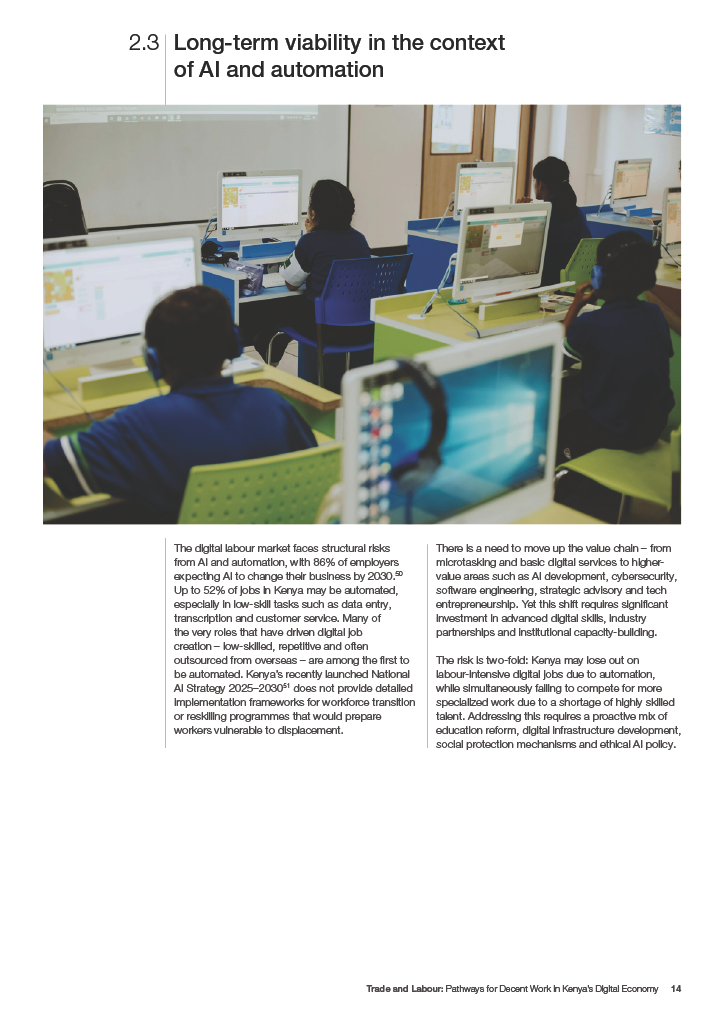
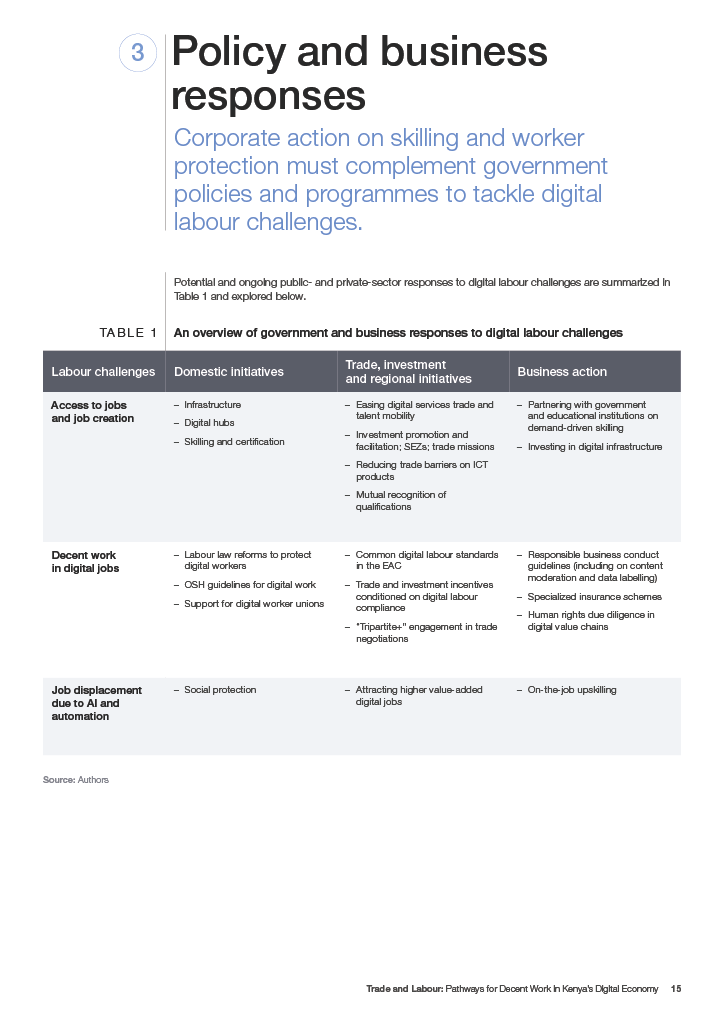
This juxtaposition between deep digital integration and thin labour governance poses a foundational policy question: do we want the digital transition to deliver digital dividends—broad-based, equitable gains in productivity, inclusion, and rights?
Or do we risk embedding a dependency trap, where countries and workers supply labour and data but lack the institutional leverage to shape how those inputs translate into sustainable and dignified livelihoods?
This question connects directly to current global policy debates, including the ILO’s ongoing standard-setting discussions on decent work in the platform economy.
A meaningful international standard cannot be treated as an add-on to macroeconomic or digital strategies. It must address how labour protections operate across borders, how algorithmic management interacts with fundamental rights, how data governance intersects with social protection, and how collective voice can be exercised when workplaces are organised through code rather than contracts.
Indonesia: Green growth and the challenge of a just transition
We observe a parallel dynamic in a very different context. Our research examined Indonesia’s nickel value chain, which sits at the centre of the global green and energy transition. Trade and industrial policies have driven rapid upgrading through domestic processing and clean-energy investment incentives, creating significant local employment—more than 180,000 jobs.
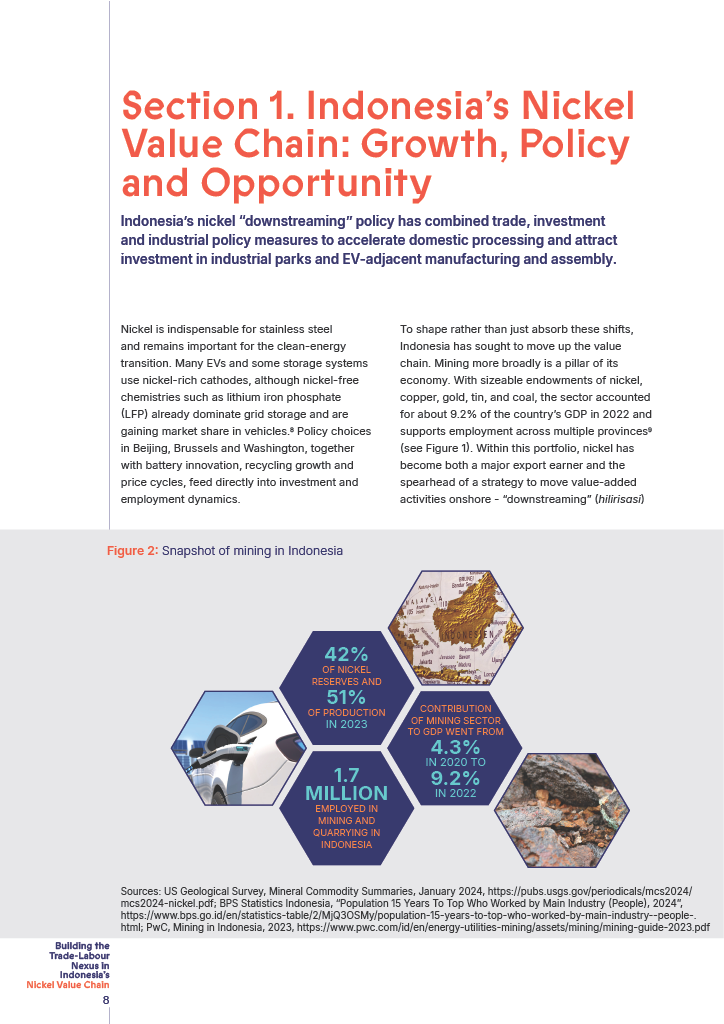
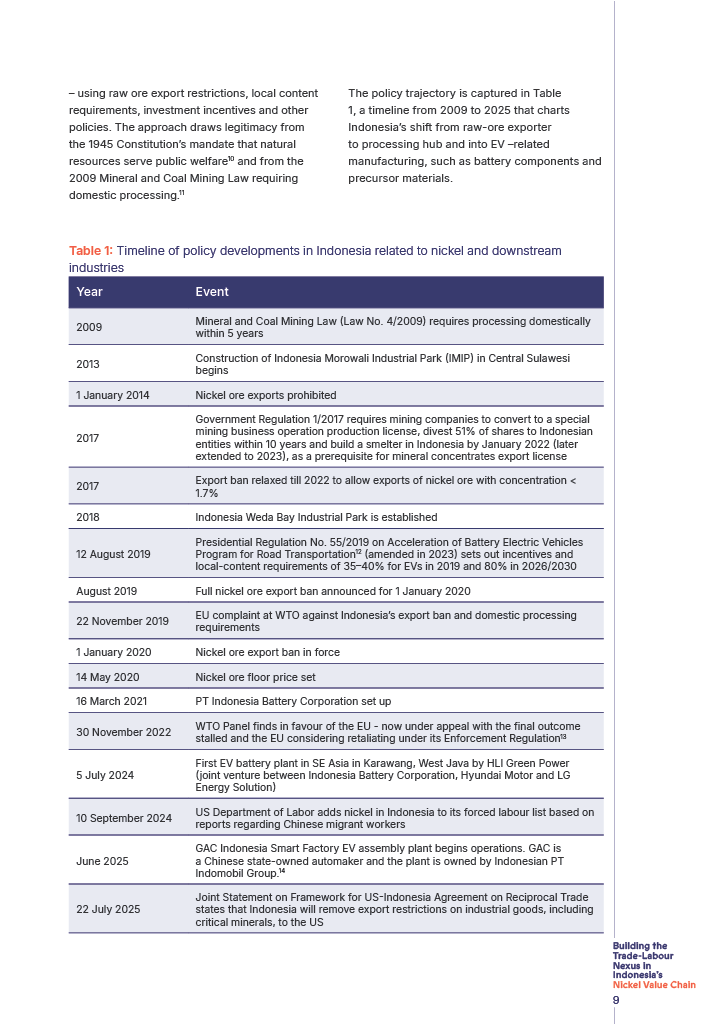
In this sector, labour standards formally apply, and labour provisions increasingly appear in critical minerals trade agreements. The EU–Indonesia Comprehensive Economic Partnership Agreement (CEPA) includes a Trade and Sustainable Development chapter referencing ILO standards, including freedom of association, collective bargaining, and prohibitions on forced and child labour.
More recently, under the US–Indonesia trade agreement, Indonesia committed to prohibiting forced labour imports and strengthening workers’ rights, including freedom of association and collective bargaining.
Yet, as in Kenya, compliance and enforcement have struggled to keep pace with the speed of industrial expansion.
Worker voice remains weak in industrial parks, and occupational safety risks in nickel smelters still persist.
The lesson from Indonesia—and from other countries facing similar dynamics—is clear: can industrial growth deliver a just transition, grounded in decent work and inclusive development? Or does it risk locking in new forms of injustice and exclusion?
The alignment challenge
Kenya and Indonesia are very different countries, operating in different sectors and production models. Yet our research points to a shared conclusion. The issue is not a lack of labour standards. Standards alone cannot deliver a fair transition. Implementation matters.
Our case studies show that when economic policy and labour governance are misaligned, that misalignment itself becomes a labour risk factor. When the alignment gap widens, adjustment costs are shifted onto workers through precarity, informality, and unsafe conditions. Alignment ultimately comes down to a choice: between economic transformation governed by thin rules, and transformation anchored in enforceable norms, institutional capacity, and social dialogue.
That is the terrain—at least one key dimension of it—on which the trade–labour nexus operates today.

The Trade and Labour Programme convenes stakeholders across trade and labour research, policy and practice to examine how economic, digital and climate transitions can deliver more just and inclusive outcomes. Through fieldwork, multistakeholder dialogue, and policy engagement, the programme is building momentum for a global trade system that is socially responsive, economically resilient, and fit for the future of work, and the future of working together.
📬 Interested in joining this dialogue? Get in touch with us.